For two seasons I kept a lacrosse ball in the side pocket of my golf bag. It was a cheap little tool that fit in my hand, and when my lower back locked up on the 14th tee I could drop it on the cart path, lie down, and roll out the knot. It worked, sort of. Then my wife Linda bought me a Magic Back Support stretcher for my birthday, and after three months of using both, I can tell you they are not the same tool. They are not even the same kind of tool. One of them got me through the back nine. The other one got me through the winter.
Here is the short answer: if you need something right now, on the course, to loosen a specific spot, the lacrosse ball wins. If you need something that actually changes how your back feels the morning after a round, the Magic Back Support stretcher wins by a wider margin than I expected. I am 61, I have a bulging disc in my lower back that was diagnosed when I was 52, and I play 18 holes two or three times a week at a municipal course in Albuquerque. I am not a doctor or a physical therapist. I am just a retired land surveyor who has spent ten years trying to find what works.
| Magic Back Support Stretcher | Lacrosse Ball | |
|---|---|---|
| What it does | Lies under your lower back and uses your body weight to stretch the spine and surrounding muscles in a controlled arch | Digs into one specific muscle knot at a time with direct pressure |
| Time to feel it | About 2 to 3 minutes of lying still before the lower back starts to release | Immediate, sometimes within 30 seconds of finding the right spot |
| Ease of use | Lie down on the floor, position it under your lower back, relax, breathe | You have to find the knot, get your weight onto the ball, and keep adjusting as it releases |
| On the course | Not practical mid-round; it needs a clean, flat, quiet spot | Fits in a golf bag pocket and works on grass, a bench, or a cart path |
| Morning-after effect | Consistent relief the next morning when used the night before a round | Helps in the moment, but the effect rarely lasts into the next day |
| Risk of overdoing it | Low, because the arch is fixed and your body weight is the only pressure | Moderate; it is easy to press too hard on a nerve or a rib and wake up sore |
| Best for | A golfer whose back is stiff after sitting, driving, or sleeping | A golfer with one specific knot that needs attention right now |
Where the Magic Back Support Stretcher Wins
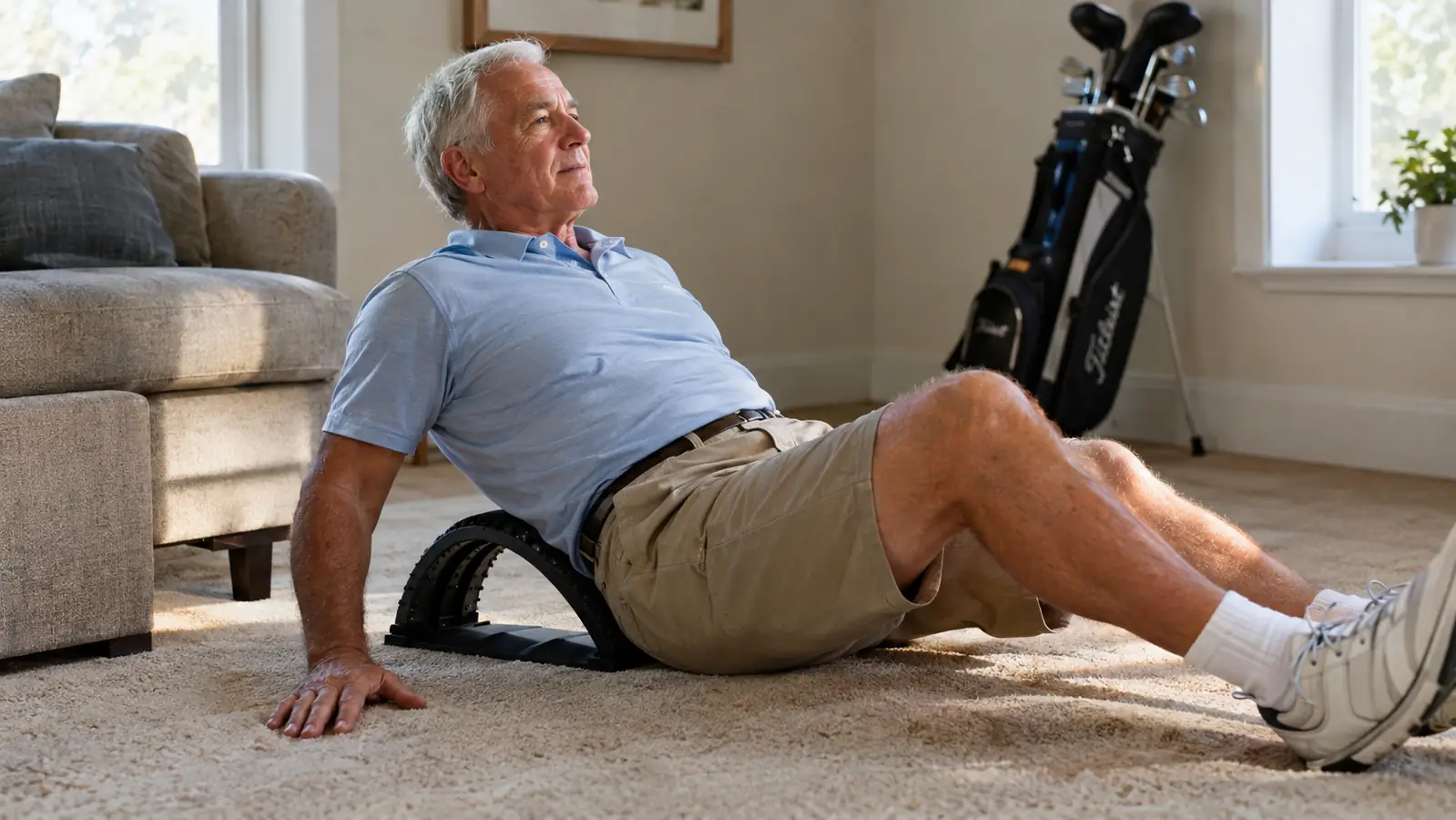
The Magic Back Support stretcher wins the only category that matters to me: how I feel the next morning. A lacrosse ball is a spot treatment. It finds the one angry knot in my lower back, grinds on it for a few minutes, and gives me maybe an hour of relief. The Magic Back Support stretcher does something different. I lie on the floor with it under my lower back for five minutes, and the whole area slowly opens up. It is not a deep, aggressive pressure. It is more like the stretch you get when you hang your arms over the back of a couch, except it is aimed exactly at the lumbar area where my disc problem lives.
The other big win is consistency. With the lacrosse ball, I only used it when something hurt. With the Magic Back Support stretcher, I built it into my evening routine: five minutes after dinner, three or four times a week. After about two weeks, I noticed that the stiffness I used to feel when I first stood up from my desk was just not there as often. My wife noticed that I stopped groaning when I bent over to tie my shoes. That is the kind of result that does not show up in a single session. It shows up over a month of using the thing regularly.
I should tell you that my first two weeks with the Magic Back Support stretcher were not all smooth. The first night I put it too high, and it landed under my ribcage, which pushed my chest up in a way that felt wrong. I moved it down until the widest part of the arch sat right at my belt line, and that was the whole difference. Since then I have settled into a timing that works: I set a timer on my phone for five minutes, breathe in through my nose and out through my mouth, and try to let my arms go heavy on the floor. The stretcher spreads the support across the whole width of my lower back instead of concentrating it on one hard ridge like a rolled towel does. I own the rolled towel trick too. The problem with the towel is that it flattens out after about ninety seconds and leaves a hard ridge digging into one spot. The Magic Back Support stretcher holds its arch for the full five minutes. That is a small mechanical difference, but it is the difference between a stretch that actually lasts and one that fades before your back opens up.
Let me give you a specific example. On a Saturday in late March, I drove 45 minutes to a course on the other side of town for a 7:30 tee time. My back was already tight from the drive, and by the 6th hole I was favoring my left side on every swing. I finished the round, came home, and lay on the living room floor with the Magic Back Support stretcher for about six minutes while Linda made lunch. That evening Linda and I walked around the block twice, which I had not managed the day after a round in months. The next morning I bent over to lace up my boots without holding onto the kitchen counter. That was the moment I stopped thinking of the stretcher as a birthday gift and started thinking of it as part of my routine.
The stretcher that made my mornings easier
I have used the Magic Back Support stretcher almost every evening for three months. It is the closest thing I have found to a reliable way to unwind my lower back before bed. Check today's price on Amazon and see if it fits your routine.
Amazon Check Today's Price on Amazon →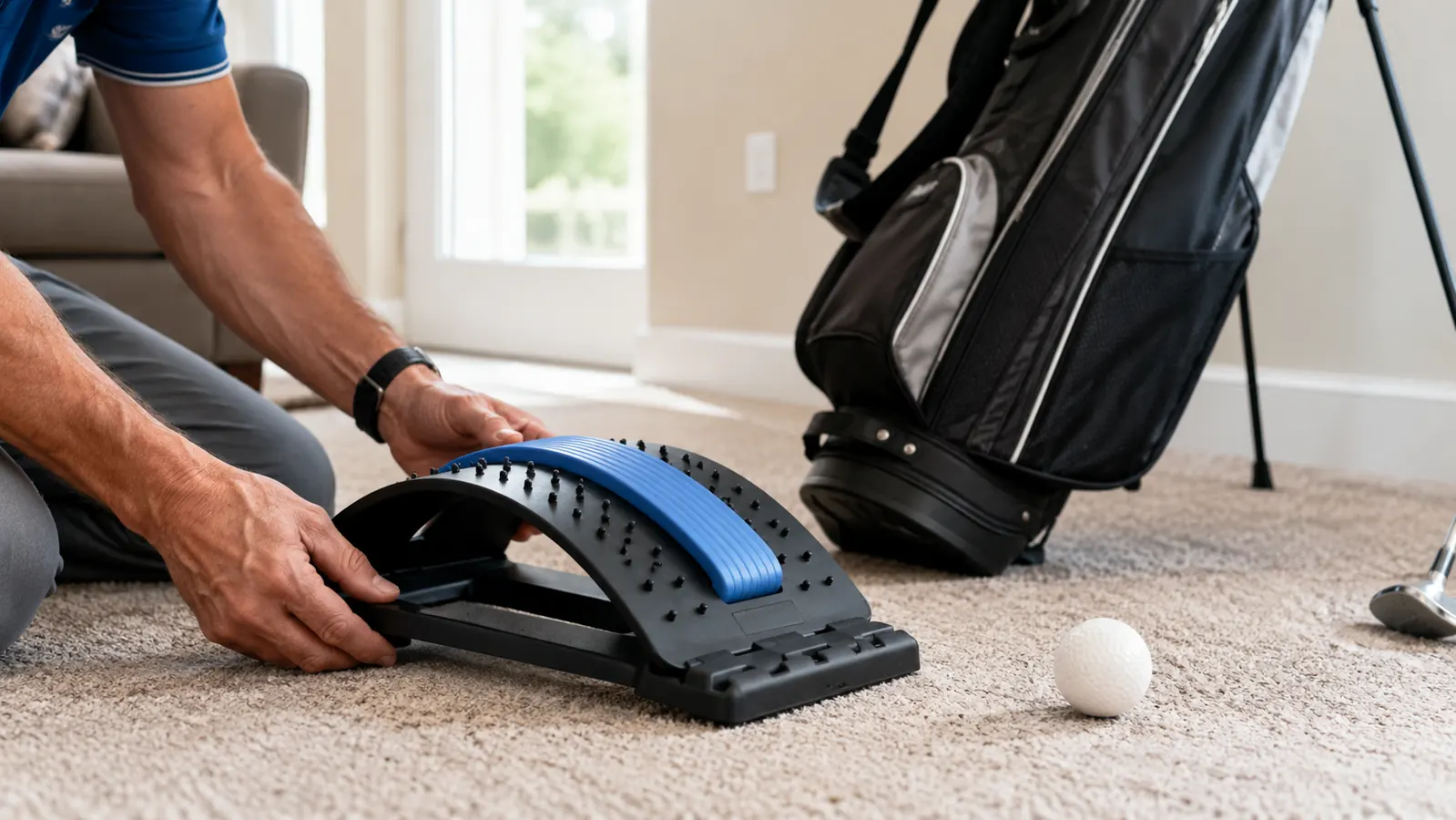
Where the Lacrosse Ball Wins
I am not going to pretend the lacrosse ball does not have a place. It absolutely does, and for one specific job it is better than the Magic Back Support stretcher: mid-round rescue. There is no way I am lying down on the 14th fairway with a curved piece of plastic under my back. But I have absolutely dropped a lacrosse ball on the edge of the cart path, sat on it, and rolled out a knot that was threatening to ruin my round. It takes thirty seconds to find the spot and another minute to work it loose. The Magic Back Support stretcher cannot do that. It needs a clean floor, a quiet room, and five minutes you are not going to have between the turn and the 10th tee.
The lacrosse ball also wins on price and portability. It is cheap, it weighs almost nothing, and it lives in my golf bag year round. I have used it in the parking lot before a round, on a bench at the turn, and once on the floor of the clubhouse bathroom. It is also better for targeting one specific spot. When I have a knot the size of a quarter right next to my spine, the lacrosse ball finds it and works it out in a way that a broad arch stretcher never could. The Magic Back Support stretcher is a whole-back tool. The lacrosse ball is a sniper.
Here is the day that convinced me to keep both. It was a Tuesday in early May, and I had skipped my evening stretcher session for three nights in a row because we were painting the guest room. By Thursday my back was tight enough that I almost called the course to cancel. I threw the lacrosse ball in my bag anyway, and on the 12th hole I found a knot just above my right hip that had been bothering me for a week. I sat on the ball against a bench at the tee box for maybe two minutes, and the knot let go enough that I finished the round. That night I used the Magic Back Support stretcher for the first time in four days, and the next morning I felt like myself again. The ball got me through the round. The stretcher got me through the week.
There is one more thing the lacrosse ball does that I should mention honestly. It is better than the Magic Back Support stretcher when the problem is a single spot that has been bothering you for days, not a general ache. In mid May I had a knot in the meat of my glute that had survived two rounds and four nights of stretching. The Magic Back Support stretcher loosened the whole area around it, but the knot itself stayed. On a Sunday afternoon I sat on the ball against the headboard of my bed, found the knot, and pressed on it for about three minutes with my own body weight. It released with a pop I could feel more than hear. That is the honest trade. The stretcher changes how my back feels overall, and the ball changes what happens at one specific point.
For what it is worth, the lacrosse ball was not my first attempt either. I tried a tennis ball first and it was too soft. It squished flat under my weight and I could not get enough pressure into the knot. I tried a foam roller next and it was too broad, hitting the whole muscle at once and never finding the spot. I tried a length of PVC pipe from my workshop and that was too hard, a little like rolling on a curb. The lacrosse ball sits in the middle. It is firm enough to press through a layer of muscle, but it has just enough give that it does not feel like a rock. You can control the pressure by how much weight you put on it. Sitting straight on it with both feet flat is strong pressure. Leaning against a bench with one leg taking most of your weight is gentler. That range matters on a golf course, where you are usually working through a pair of shorts and you do not want to leave a ball-shaped bruise in the middle of your back for the rest of the round.

Who Should Buy Which
If you are a golfer whose back only bothers you during a round, and you just want something to carry in your bag for emergencies, buy the lacrosse ball. It costs almost nothing, it takes up no room, and it will get you through the occasional tight spot. If you are a golfer like me, whose back is stiffest in the morning, after a long drive to the course, or the day after a round, the Magic Back Support stretcher is the better investment. It does not do what the lacrosse ball does, and the lacrosse ball does not do what it does. They are not competitors. They are a team.
My honest advice is to start with the Magic Back Support stretcher and keep a lacrosse ball in your bag. Use the ball when you need to survive the next hour. Use the stretcher when you want to feel better tomorrow. And if your back pain is sharp, radiating down your leg, or getting worse, do not take advice from a retired land surveyor. Talk to your doctor or a physical therapist. That is what I did when I was diagnosed at 52, and it is the only reason I am still walking 18 holes at 61.
If you are still making up your mind, here is how I think about the two of them now. The lacrosse ball is a repair tool for a specific afternoon. The Magic Back Support stretcher is a maintenance tool for the whole month. I carry one and I use the other. On a Tuesday night after dinner I am on the living room floor with the stretcher for five minutes. On a Saturday at the turn I am sitting on the ball against a bench for ninety seconds. They take different amounts of time and they live in different places. I do not think you have to choose. I bought the ball first because it was cheap and it kept me playing. I bought the stretcher second because I got tired of waking up stiff. If I had to give one to a friend who was just starting to have back trouble, it would be the stretcher. The ball is the thing you add when you realize you need something you can reach for mid-round.
Start with the stretcher, keep the ball in your bag
The Magic Back Support stretcher is the tool I reach for almost every night. It will not replace your doctor, your physical therapist, or a good warmup, but it earned a permanent spot in my evening routine. Check today's price on Amazon.
Amazon Check Today's Price on Amazon →