
The morning after a round used to be the part I dreaded. Not the round itself. I still play 18 holes two or three times a week at the municipal course here in Albuquerque, and I walk with a push cart whenever the weather lets me. The part that got me was the next morning, when I swung my legs out of bed and my lower back said something unfriendly. Ten years of stiffness, a bulging disc that showed up on an MRI when I was 52, and a forty-minute ride home in my old pickup that never loosened anything. Ibuprofen helped until it wore off. The stretches I did in the parking lot helped until I got home.
I have tried a lot of fixes in that decade. A foam roller that lives in the garage. A lacrosse ball I was told to lean against a wall with. A chiropractor I saw for a while. Each one worked a little, right up until it did not. Then, last fall, I picked up something I had seen golfers mention more than once: the Magic Back Support stretcher, a simple device you lie back on for a few quiet minutes. This is my review after months of using it, mostly in the evenings after a round and some mornings before one. It has not turned back the clock. It has changed which mornings are hard.
The Quick Verdict
A simple, honest tool for easing lower back stiffness after a round. It will not fix a disc and it will not cure anything, but it has changed which mornings are hard for me. The best ten minutes of the day for my back.
Amazon Check Today's Price →Six months in, this is the one piece of gear I actually use every week
The Magic Back Support stretcher has moved into the corner of my living room and it gets used nearly every day. If plain lower back stiffness is cutting into your golf, check today's price on Amazon and decide for yourself.
Amazon Check Today's Price on Amazon →How I've Used It
I will be honest about how this started. I did not read the instructions the first night. I laid the device on the living room rug, lay down on it, and found out immediately that my lower back was not going to relax into the position it wanted. I fiddled with the adjustment and started on the gentlest setting. Even that felt like a lot for the first minute. The leaflet says to start low and work up, and I should have listened. I did, starting the next night.
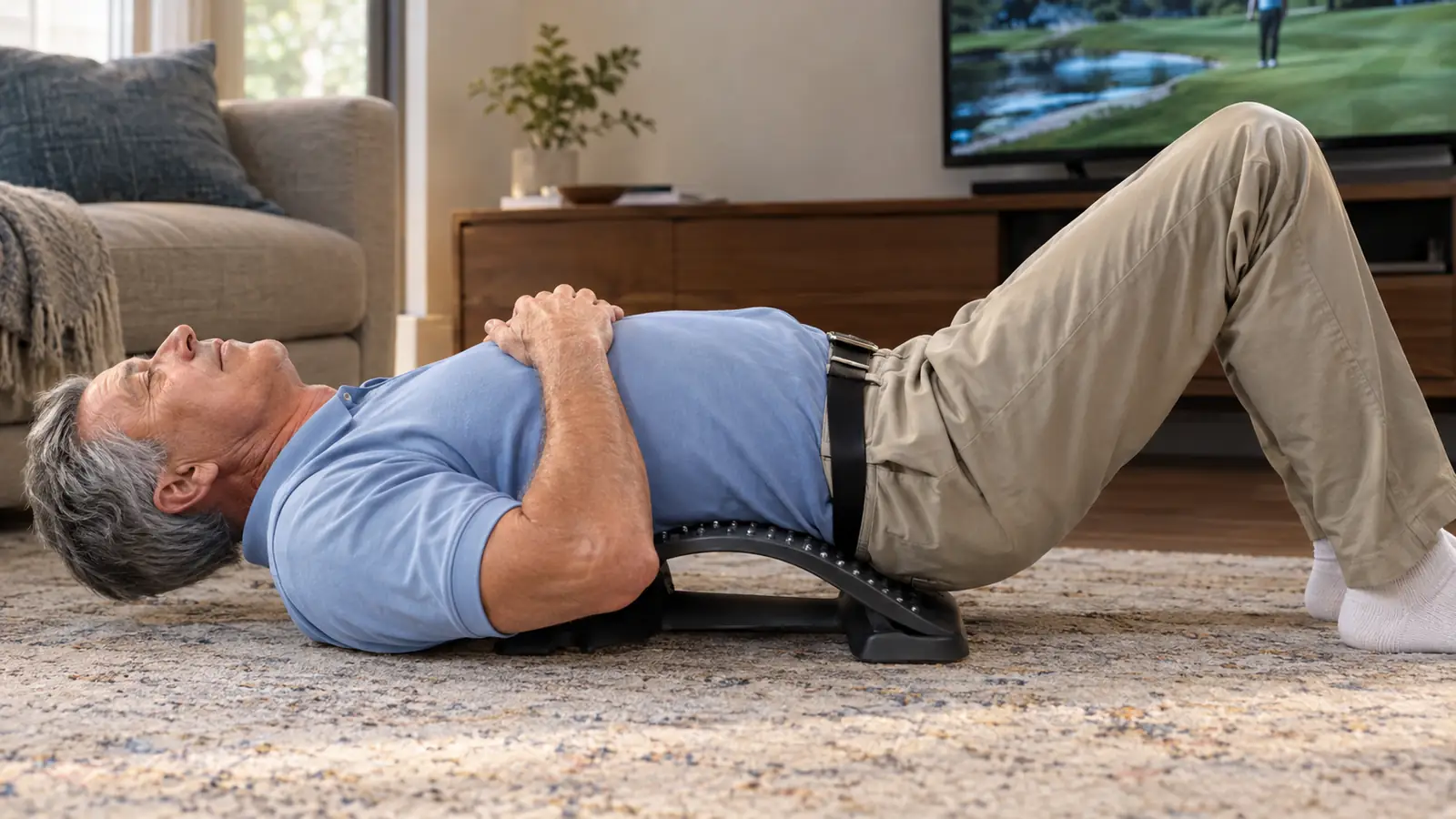
By the second week I had a routine. After a round I come home, unload the push cart from the truck, and put the Magic Back Support stretcher down on the rug in front of the TV. Ten minutes lying back on it with my knees bent and my hands resting on my chest. That is the whole routine. I set a timer, because ten minutes on a back stretcher is longer than it sounds. My wife Linda points out that I look like a beetle that got flipped over. It is a fair observation.
In the mornings when I have a tee time, I use it for about five minutes before I leave, especially if the drive to the course is going to be more than twenty minutes. The drive is one of the worst parts of the day for my back. The bench seat in my old truck has no give left in it. I carry a 14 handicap, which means I am good enough to care about my score and bad enough that my back knows it. Stretching before the drive, and again after I get home, has made a bigger difference than anything I have tried in the last decade.
Some nights I use it and then go straight to bed. Other nights I do the ten minutes, get up slowly, and walk a few laps around the kitchen island to let my lower back settle before I sit down again. That little walk, the stretcher, and going to bed on a flatter back than I arrived home with: that is the whole evening routine. It does not sound like much. It has done more for me than the hour-long sessions I used to force myself through with the foam roller.
What a Back Stretcher Actually Does
Here is the plain-English version, because I am not a doctor or a physical therapist and I am not going to pretend otherwise. The device is a firm support with several height settings. You lie on your back with it positioned under the curve of your lower back, and it eases that part of your spine into a gentle backward bend. It holds the position for as long as you are willing to lie there. If that sounds like the opposite of curling up in the recliner, that is exactly the point.
Why does that help? A physical therapist explained it to me once, and the version that stuck is this. When your lower back has been loaded for four hours of walking and swinging, the muscles and soft tissue around the disc get stiff and guarded. Lying in a slight backward bend for a few minutes lets them stop guarding. Blood flow picks back up. The nerve that was complaining stops complaining as loudly. None of this is mysterious. It is positional and mechanical, and it is free if you already own the device.
The multi-level part matters more than I expected. The gentlest setting is where I started. After a few weeks I moved up one level and stayed there. The way I think about it now: it is not about getting the most extreme stretch you can tolerate. It is about finding the level that feels like it is working without making you brace against it. If you are holding your breath or clenching everything, the setting is too high. That rule has served me well for months.
I also learned that it works better on warm muscles. Stretching right after a shower, or after the muscles have loosened from a little walking, gets me a deeper result than stretching cold first thing in the morning. On days when I have time, I do a slow walk around the block and then five minutes on the device. On days when I do not, the device still helps, but I can tell the difference. It is the difference between asking relaxed muscles to lengthen and asking cold ones to give way.
Six Months of Mornings After a Round
I have been using the Magic Back Support stretcher since early fall, which means I have been through the awkward first week, the routine-building second month, and the stretch of winter when I played less and sat more. The honest summary is that it has become the most consistent piece of equipment in my routine, and it is not close. That surprised me, because I have a garage full of things I bought with good intentions.
The clearest evidence is the morning test. Before this stretcher, a hard walk of 18 holes meant a rough night and a slow start the next day. Getting out of bed was a two-stage operation: roll onto my side, push up with both hands, wait a beat before standing. That beat, the little pause where my back decides whether it is coming along, is gone on most mornings now. I still have bad days, especially after a round where I swung badly and spent four hours over-swinging. But the pattern has changed. The bad mornings used to follow every round. Now they follow the rounds where I hurt myself swinging, not the rounds themselves.
The other thing I learned is that the stretcher does more for me when I use it every day, not just after golf. When I skip it for a week, the stiffness creeps back in and I notice the difference on the course. I do not think the device is doing anything fancy. I think consistency is the entire game. It is the same reason the lacrosse ball stopped working for me. I was not consistent with it, and it rolled under the couch.
I also want to be honest about what it has not done. It has not gotten rid of the tightness completely. I still get a dull ache after a long drive. I still have a morning or two a month where the old two-stage wake-up is back. And the mornings after I played late and then sat in the truck for forty minutes are never as good as the mornings after I walked and stretched. The Magic Back Support stretcher is a tool in a kit, not the whole kit.
Where It Helps, and Where It Doesn't
Let me be clear about when I reach for the stretcher and when I do not. I use it for stiffness: the dull, achy, tight feeling that has been my companion for about ten years. I do not use it when something is sharp or shooting. If a pain runs down my leg or makes it hard to stand up straight, I call the doctor's office. A back stretcher is not the answer to an acute problem, and anyone who says otherwise is selling something. The rule a PT gave me years ago still holds: if the pain changes character, stop guessing and get it looked at.
I also found the position awkward at first, and I want to be honest about that. It is not a passive fix. You have to lie there and let it work, and the first couple of sessions were not relaxing. If you want a device that does the work while you do something else, this will frustrate you. It works precisely because you are not doing anything else. Once I made peace with that, it got easy.
One more honest note. The listing mentions using it in bed, in a chair, and in the car. I tried it in my office chair for about four minutes and decided that was not for me. On the bed it works if the bed is firm. On the floor it works best. Your mileage will vary, but the floor, on a rug, in front of the television, is the honest answer from my house.

Alternatives I Considered
I compared this with the usual suspects before I bought it. The foam roller is cheaper, true, and it lives in my garage mostly untouched, because using it properly means getting into an awkward position on the floor that I found easy to skip. The lacrosse ball is cheap and does a real job on knots, but it never did anything for the general stiffness across my lower back. A friend at the club swears by an inversion table and has the ceiling reinforcement to prove it. I did not want to hang upside down. The Magic Back Support stretcher won because it was the easiest thing for me to actually do, and the easiest thing to do regularly is the one that works.
The other alternative I considered was doing nothing, which is what I had been doing on plenty of weeks. It has a predictable result. I get stiffer. Golf gets less fun. The round after the round gets shorter because I am protecting my back instead of swinging. That is the real competition this device is up against: the status quo. Once you put it that way, ten minutes on the rug in front of the TV is an easy habit to keep.
The longer I use it, the more I think the device is the easy part. The hard part is building a habit around it, and that is true of every piece of back equipment I have owned. What made this one different is that it is not punishing. The foam roller asked me to hold painful positions. This asks me to lie still. Ten minutes of lying still, every day, has been easier to keep than anything else I have tried, and easier is what actually gets done.
What I Liked
- Easy to use daily. Ten minutes on the rug in front of the TV is not a hard habit to keep
- Multiple settings let you start gentle and work up at your own pace
- Quiet, no batteries, no app, no subscription, nothing to charge
- Noticeably softened the morning-after stiffness from golf within a few weeks
- Made getting out of bed a one-stage operation on most mornings
Where It Falls Short
- Does not help with sharp or shooting pain. That is a call to the doctor, not a stretch
- The position takes getting used to. My first session was not comfortable
- Consistency is the whole game. Skip a week and the stiffness creeps back
- The car and chair uses did not work for me. It is a floor tool in my house
The bad mornings used to follow every round. Now they follow the rounds where I hurt myself swinging, not the rounds themselves.
Who This Is For
This is for recreational golfers, weekend players, people who walk with a push cart and pay for it the next morning. It is for anyone with plain, achy lower back stiffness who is tired of owning equipment they do not use. If your doctor or physical therapist has told you to stay active, and your back complains after a long round or a long drive, the Magic Back Support stretcher is a reasonable thing to try. It does not need batteries, an app, a subscription, or a trip to a facility. It needs a patch of floor and ten minutes.
Who Should Skip It
Skip it if you are dealing with sharp, shooting, or radiating pain. Get that checked by a doctor first. Skip it if the pain showed up after a fall or a specific injury. If you cannot comfortably get up and down from the floor, this is not the tool for you, and there is no shame in that. And if you are hoping for a product that eliminates back pain or fixes a disc, skip this too. Nothing I have found in ten years does that, and anyone who claims otherwise is not being straight with you. This is a maintenance tool. It earns its spot because it is honest about what it is, and what it is not.
If your back talks to you the morning after a round, this is worth a look
The Magic Back Support stretcher has done more for my Sunday mornings than any gadget I have owned. No gimmicks, no promises it cannot keep. Check today's price on Amazon and see if it belongs in your routine.
Amazon Check Today's Price on Amazon →