

There is a particular kind of dread I recognize the second I feel it. I am standing at the counter in the pro shop, paying my green fee, and my lower back has that tight, stiff feeling that means it did not like the drive over. Maybe you know the one. You have a tee time, you already paid for 18 holes, and the last thing you want is to spend the first three holes swinging like a man who just climbed out of a car that was too small for him. Nothing about that feeling is new to me. I have had a bulging disc in my lower back since my early fifties, and ten years of playing golf with it has taught me a few things about getting through a round without making the next morning worse.
What helped me most was not a complicated program or some clever piece of advice. It was a routine, and at the center of that routine is a tool I did not expect to rely on as much as I do. It is the Magic Back Support Stretcher, a multi-level lumbar stretcher you can use on the floor of your bedroom, on the seat of your car, or on the grass by the first tee. I have used mine for about a year now, and this is the exact sequence I follow when my back is tight before tee time. One honest note before I go on: I am a retired land surveyor, not a doctor or a physical therapist. This is what works for me at 61 with a bad disc. If your back pain is sharp, radiates down a leg, or keeps getting worse, talk to your doctor or a physical therapist first. That advice is worth more than anything else in this article, and I mean it.
The Stretcher That Made the First Tee Feel Like a Warm-Up
The Magic Back Support Stretcher has lived in my truck since last spring. Ninety seconds on the floor or a quick pass on the bench before the first tee, and the tightness steps back. Multiple levels, so you can start easy on a stiff morning. Check today's price on Amazon and see the current listing for yourself.
Amazon Check Today's Price on Amazon →Step 1: Give Yourself Thirty Extra Minutes
Most of the pressure on a stiff morning happens before you ever swing a club. You sleep in a little, you rush the coffee, you throw the clubs in the truck, and you arrive at the course with just enough time to pay and jog to the first tee. That is the exact wrong order for a back that started the day tight. I know because I did it for years. I would show up stiff, force myself through the first three holes, and spend the rest of the front nine trying to catch up with how I should have felt on the first tee.
Now I plan for thirty extra minutes before every tee time. That does not mean thirty extra minutes of stretching. It means thirty minutes of not being in a hurry. I get to the course with time to check in calmly. I put my shoes on sitting down instead of balancing on one leg. I take the long way to the parking spot. The calendar does not care about my back, but my back responds well to not being rushed, and so does the rest of my round.
Here is the thing I noticed after I started doing this. The rounds where I rushed to the first tee were not just stiffer rounds. They were worse golf. When your back is tight, your turn shortens, your arms take over, and the club goes where it wants instead of where you want. An extra half hour in the morning has turned more of my bad rounds into decent ones than any swing tip I have ever paid for.
Step 2: Use the Magic Back Support Stretcher Before You Leave the House
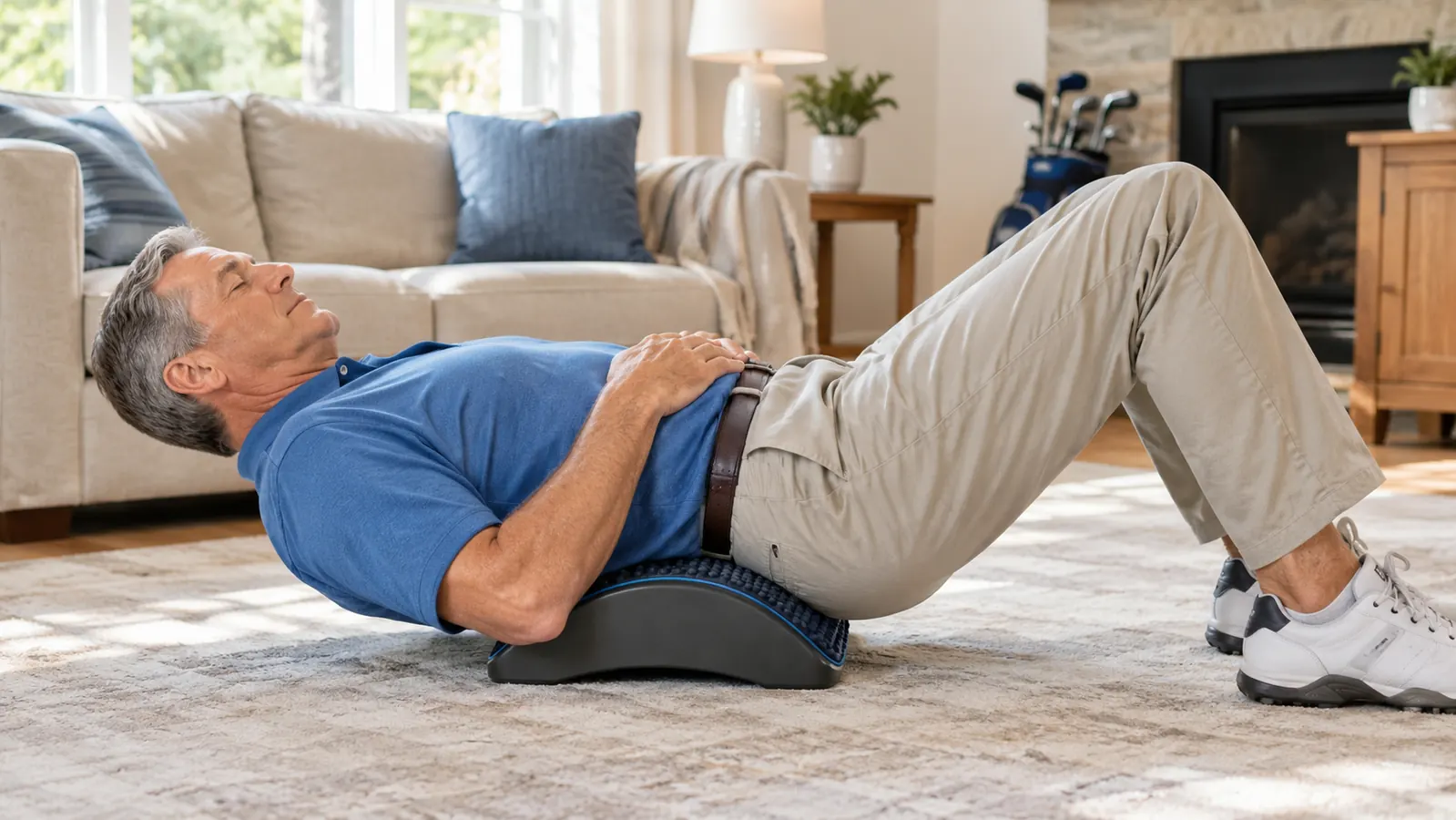
I use the Magic Back Support Stretcher on the living room floor before I put my golf shoes on. The routine is simple. I lie on my back on the floor with my knees bent and my feet flat. I slide the stretcher under my lower back so it sits right where the stiffness lives. I start on the gentlest level, or the second level if I feel okay. I breathe slowly and let the stretcher do its work. I aim for ninety seconds, and I go to two minutes when the back really tightened up overnight.
The first few weeks, I tried to push it. I wanted the deepest setting because more felt like better. That was a mistake, and the next morning told me exactly how much of a mistake it was. Now I treat the level the way I treat a club selection. I start conservative and I only move up when the lower levels feel genuinely easy. On a stiff morning, I almost never go past the middle settings. The point of this step is to take the edge off before I ask my body to swing a golf club. It is not a test of how much I can take.
The Magic Back Support Stretcher is not a cure for a bad disc, and I am not going to pretend it is. There are mornings nothing makes the back feel young again. But the morning routine turns a stiff, cranky back into one that is willing to cooperate for a few hours. That is a fair deal for ninety seconds on the living room floor, and it is exactly what I need before a round.
Step 3: Walk Before You Swing
After the stretcher, I do not walk straight to the practice area and grab a driver. I walk first, with no club in my hand at all. I park the truck on the far side of the lot on purpose. I take the long way to the clubhouse. I do a full loop around the putting green before I touch anything. Your lower back needs a few quiet minutes to wake up the muscles around it, and walking is the quietest way I know to do that. It gets blood moving without asking the back to do anything dramatic.
Then I warm up with short clubs before anything else. I start with a wedge and hit five or six easy shots. I let the swing build itself instead of forcing it. If I try to rip a driver when the back is still waking up, I pay for it on the fifth hole, not the first. The back hates surprises, and the walk plus the easy wedge shots mean nothing on the course is a surprise.
I also make sure I am not loading the truck awkwardly. The clubs go in the bed gently, one at a time, with my knees bent. It sounds small, but the way you pick things up off the ground is the way your back remembers you, especially at my age. I stopped lifting anything heavy right before a round, including the bag when I carried it. That one change alone saved me from a few rounds that would have started badly.
Step 4: Do a Short Second Pass Right Before the First Tee
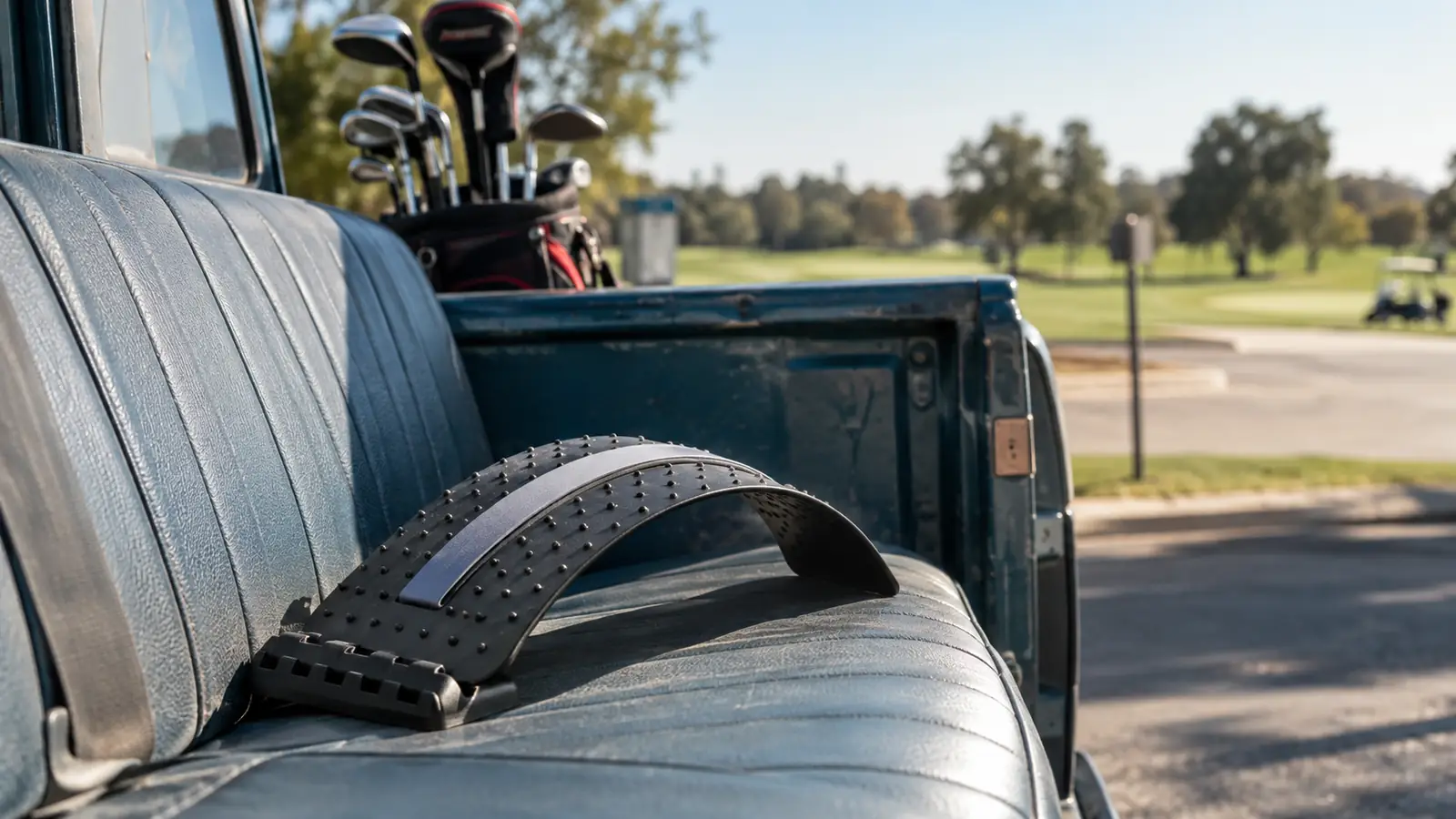
This is the step that changed my rounds the most, and it is the one almost nobody does. Right before I walk to the first tee, I find a bench or a stretch of grass near the tee box, and I do a short pass with the Magic Back Support Stretcher. Sixty seconds on the gentlest level. That second pass does something the morning session does not. It reminds my back, at the exact moment the round is about to start, that it is loose and ready to work.
The first tee is where the adrenaline hits, and adrenaline makes your muscles tighten without you noticing. You are not thinking about your back on the first tee. You are thinking about the group watching you and the fairway in front of you. The sixty-second reset before the first tee has saved me more bad holes than any swing advice I have ever read. It takes less time than one extra practice swing, and it sets the tone for the whole morning.
I do the same thing at the turn when the back starts talking. It happens more than I would like, usually around the tenth hole after sitting in the cart for a few minutes or standing around waiting to hit. The stretcher comes out of my bag, I take a minute on the bench, and I go back out for the back nine. That mid-round reset is the difference between finishing 18 and finishing 18 in a bad mood.
Step 5: End the Routine at the Car, Not at the 18th Green
The way you finish a round decides how you feel tomorrow morning. The morning after is when my back lied to me the most in the first few years with the disc problem. I would walk off the 18th green feeling fine, drive forty minutes home, and wake up the next day stiff as a board. The missing piece was a cooldown. Now I end the round the same way I started it: with a short pass on the Magic Back Support Stretcher, either sitting on the tailgate of my truck or lying on the grass next to the parking lot.
I also take a slow lap around the parking lot before I get in. Ten minutes of easy walking after a round keeps the muscles from seizing up while I drive. The ride home is the part that used to undo me, because sitting still in the truck for forty minutes lets everything tighten again. A short walk and a minute on the stretcher mean I walk in the front door at home as limber as I walked off the course.
And on the drive home I do not sit like a sack of potatoes. I keep a small towel rolled up in the truck, and I put it behind my lower back for the drive. It is a small thing, but it keeps my lower back supported the way the stretcher did before the round. When I get home, the routine is done. The back gets to rest, and I get to feel like I actually enjoyed the round instead of just surviving it.
What Else Helps
The Magic Back Support Stretcher is the centerpiece of my routine, but it is not the whole routine. A few other habits have earned their place over the past year. I keep the rolled towel in the truck for long drives, so the seat supports my lower back instead of fighting it. I put my golf shoes on sitting down, every time, without exception. And when the back is particularly grumpy in the morning, I use heat before I get out of bed. Ten minutes with a heating pad on my lower back beats an hour of trying to stretch it out cold.
I also walk with a push cart instead of carrying my bag. I carried my bag for years, and my back was fine with it until it was not. A bulging disc does not care about pride. The push cart takes the weight off my lower back and lets me walk the course the way I want to. If you carry your bag and wake up sore the next day, that is the first thing I would change. Talk to your doctor or physical therapist about what they think is safe for your specific back before you add anything to your routine, including this stretcher.
One more thing that surprised me: staying in better shape on the days I do not play. Two or three times a week I do a short set of exercises a physical therapist gave me years ago, mostly planks and gentle leg raises. I am not a gym person and I do not pretend to be. But the days I skip them for weeks at a time are the days my back makes itself known. The stretcher helps me on the day of the round. The exercises help me the other six days, so the stretcher does not have to do all the work.
The mornings I do the full routine are the mornings I walk off the 18th green, climb into the truck, and drive home without holding the door frame.
Start Tomorrow Morning on the Floor Before the First Tee
The Magic Back Support Stretcher is the one piece of gear I would not trade from my whole routine. It takes ninety seconds, it has multiple levels so you can go easy, and it has gotten me through a full season of golf with a bad disc. Check the current price on Amazon and see which level works for you.
Amazon Check Today's Price on Amazon →