
I am 61 years old, I have a bulging disc in my lower back, and I still play 18 holes two or three times a week at a municipal course in Albuquerque. The thing that almost ended that routine was not the swing. It was the bending. Reaching down to tee up a ball, leaning over to pick up a club, twisting to lift the bag out of the truck bed, then doing it again on every single hole. By the turn, my back was tight. By the next morning, I was moving like a man twice my age. One Tuesday a few years back, I quit after 14 holes because I had bent to the ground 40-something times and my back told me the 15th was not going to happen. That was the day I decided something had to change, because cutting back to nine holes was not an option I was willing to take. So I switched to the Caddytek CaddyLite push cart, and it changed which parts of a round actually hurt.
This is not a medical article and I am not a doctor. I am a retired land surveyor who spent decades bent over a transit and who now spends his retirement trying to stay on the course. What follows are the five changes that helped me bend and lift less during a round, in the order I made them. If your pain is sharp, radiating, or getting worse, talk to your own doctor or physical therapist before you change anything about how you play.
The cart that took the lifting out of my round
The Caddytek CaddyLite folds flat, rolls on EVA wheels, and keeps the bag at a height where I do not have to bend to reach a club. It is the reason I can still walk 18.
Amazon Check Today's Price on Amazon →Step 1: Set the handle height so your arms hang naturally
The first thing I did with the Caddytek CaddyLite was adjust the handle to match my height. I am five-foot-eleven, and before this cart I pushed a neighbor's old two-wheel cart with a fixed handle for one round. That handle came up to my rib cage, so I pushed with my shoulders hunched the whole day; by the twelfth hole I was leaning on it like a crutch. This sounds like a small difference, but it is the difference between pushing a cart and leaning on one. When the handle is too low, you hunch forward and your lower back takes the load. When it is too high, you push down and your shoulders and neck complain instead. The right height for me is where my arms hang almost straight with a slight bend at the elbow, so my hands rest on the grip without me reaching or slouching.
The CaddyLite handle adjusts in a few seconds. I set mine once at the start of the season so the grip sits just below my belt line, and I have not touched it since. Walk a few steps after you set it and check your posture in the reflection of a clubhouse window. If you are walking tall with a relaxed grip, you have it right. If you are reaching forward or rounding your shoulders, move it one notch and try again. Five minutes of fiddling on day one saves me from hunching for the next 200 rounds.
This one adjustment did more for my back than any stretching routine I tried. It also made the cart feel lighter, because I was pushing with my legs and my frame instead of hanging off the handle. That is the whole point of a push cart: the bag rides, and so does the load.
Step 2: Load the bag once and leave it on the cart
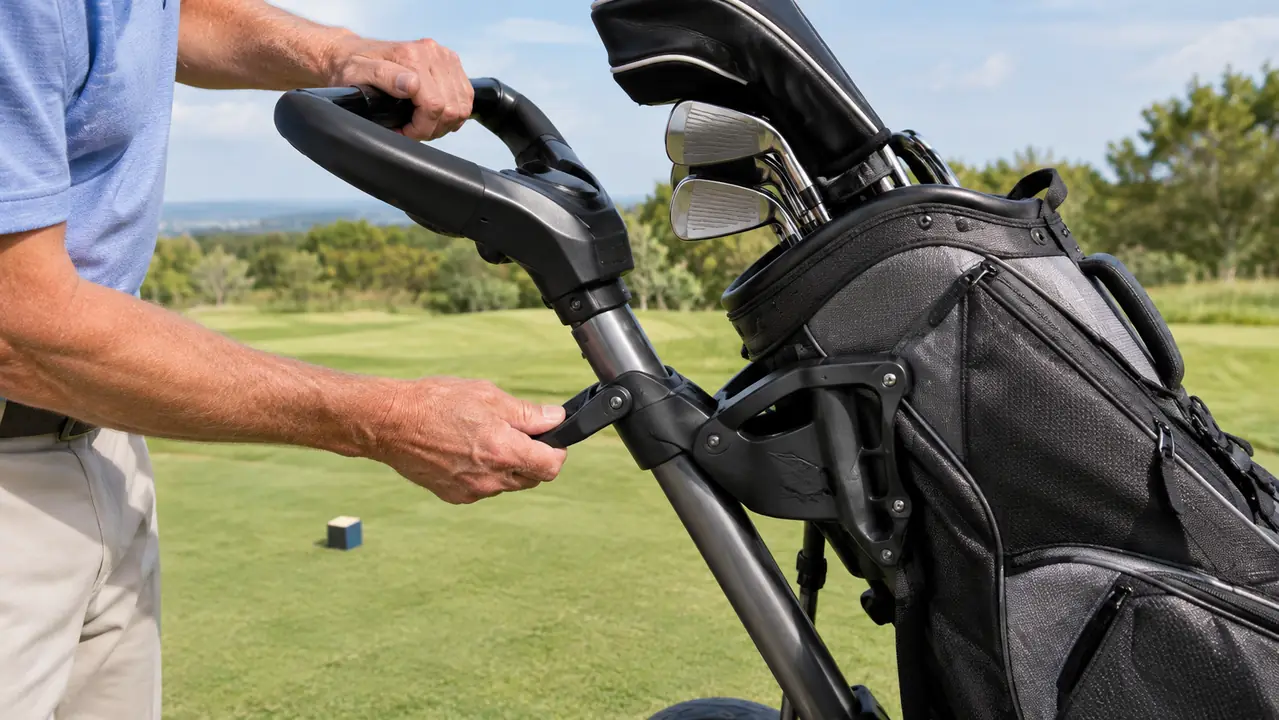
The old way, I carried my bag from the truck to the pro shop, set it down, picked it up again at the first tee, and repeated that dance at the turn and at the end of the round. My bag with clubs weighs about 24 pounds, which does not sound heavy until you have lifted it eight times in an afternoon. With the Caddytek, I load the bag onto the cart at the truck, strap it in, and it stays there until I am done. The cart has a strap that holds the bag securely, and the frame is stable enough that I do not worry about it tipping when I set it down.
The trick is to lift the bag onto the cart with your legs, not your back. I stand close to the cart, bend at the knees, keep the bag close to my chest, and set it into the cradle in one motion. Then I tighten the strap and walk. The strap takes about four seconds to tighten, and the bag has not shifted on me once, so there is no excuse to leave it loose. At the turn, I do not take the bag off. I park the cart, buy a water, and push it to the next tee. That one change eliminated about a dozen lifts per round.
If you drive to the course, the same rule applies at the truck. I keep the cart in the bed of my pickup, and I lift the bag from the tailgate straight onto the cart. No ground to tailgate, no tailgate to ground. The fewer times the bag changes height, the fewer times your back has to do the work.
Step 3: Use the cart as a club rest so you stop bending for every shot
The habit that wore on me most was the constant bending to pick up a club, set it down, pick up another one. On a normal round I was reaching down 80 or 90 times. One Sunday in May I actually counted, mostly out of annoyance: 43 bends by the time I reached the turn. The CaddyLite has a mesh net at the front of the frame where I rest the club I am not using, and I trained myself to use it. After I hit, I walk the club back to the cart and lay it in the net instead of dropping it on the grass. When I need it again, I pick it up from waist height instead of the ground.
This sounds like a small thing, but it is the difference between 80-plus bends and maybe 10. The ones that remain are the unavoidable ones, like picking a ball out of the cup or fixing a divot. Those I do with a squat and a straight back, the way my physical therapist taught me. Her one cue was to hinge at the hips, push them back, and keep my chest up, so the squat feels like sitting back into a chair and my lower back stays long. It took about a month before it felt natural, and now I do it without thinking.
The cart also has a drink holder and an umbrella holder, which means I am not bending to reach a water bottle in my bag or holding an umbrella in one hand while I push. Both of those little conveniences kept me from twisting into awkward positions that my back did not appreciate.

Step 4: Park the cart so you never twist to reach a club
Where you park the cart matters almost as much as how you set it up. Early on, I would stop the cart wherever it rolled to a halt, which usually meant I was reaching across my body or twisting to grab a club. Now I angle the cart so the bag faces me when I walk up to it. That way I pull the club straight out, no twist, no reach. I learned this the hard way a couple of falls back. I parked on a downhill slope without setting the brake, the cart rolled three feet while I was lining up a putt, and I lunged after it with a full twist of my spine. I finished the hole, but my back was angry for the rest of the round and stiff the next morning.
On the green, I park the cart on the fringe on the side of the green closest to the next tee. That saves me a long walk with the putter in my hand and keeps me from carrying anything farther than I need to. On the tee box, I park it parallel to the tee markers so I can step up, grab my driver, and step away without bending over the bag. If the next tee is far, I move the cart to the path before I mark my scorecard, so I never have to backtrack for it.
The CaddyLite has a foot brake, and I use it every time I park now. It holds the cart still on a slope, which means the bag does not shift and I do not have to chase it or bend to catch it. A cart that rolls away is a cart that makes you lunge, and lunging is exactly what a bad back does not need.
Step 5: Fold it at the car, not on the course
The last step is the one most people skip. At the end of the round, the temptation is to fold the cart right next to the 18th green so you can walk to the parking lot empty-handed. I learned the hard way that this just moves the lifting to a moment when your back is already tired. The first time I tried it, I dropped the strap, had to squat to pick it up again, and was sore before I reached the truck. Now I push the cart all the way to the tailgate and break it down there.
The CaddyLite has a quad-fold frame that collapses into a compact shape, and it stands on its own when folded. That matters more than you think. A cart that falls over when you set it down forces you to bend and grab it. A cart that stands up lets you load it into the truck with one smooth motion. I fold it at the tailgate, set it in the bed, and I am done. It takes about thirty seconds to fold, and I have managed it in the dark after a twilight round without swearing, which is my honest test of whether a design works.
The same logic applies at home. I keep the cart in the garage, unfolded, so I can roll it to the truck instead of carrying it. The less I lift, the better my back feels the next morning, and the more likely I am to play again in two days.
What Else Helps
The CaddyLite did the heavy lifting, but a few other habits made the biggest difference in how my back felt after a round. I stretch for five minutes before I leave the house, mostly hamstrings and hips, because tight hamstrings pull on the lower back. I walk the course instead of riding when I can, because sitting in a cart for four hours stiffens me up more than walking ever did. And I keep a small towel in the cart net so I can wipe my grips without bending to the ground.
I also stopped digging things out of my bag mid-round. My tees, ball marker, and phone all live in the cart console and mesh pocket now, so I am not bending into the bag to find them on every other hole. Little changes, but they add up to a round where my back is the last thing I think about.
The Caddytek CaddyLite did not fix my back. It took away about 80 bends a round, and that let my back do its job instead of mine.
Walk 18 without the wear and tear
If you are tired of your back deciding whether you play golf this week, the Caddytek CaddyLite is the simplest change I have made in years. Check the current price on Amazon and see if it fits your game.
Amazon Check Today's Price on Amazon →