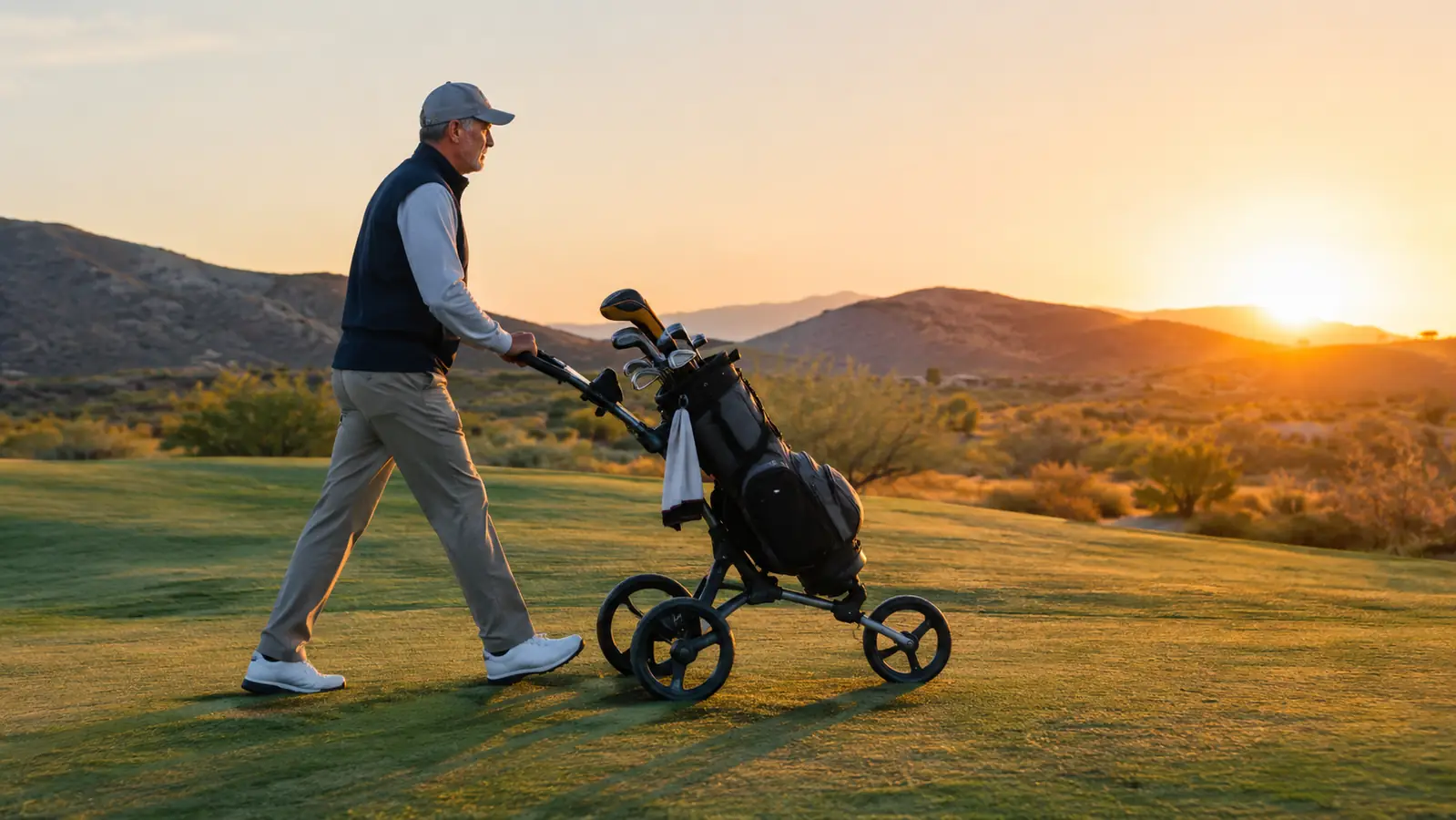
The question I hear most from guys my age on the first tee goes something like this: should I stop carrying my bag? They see me pushing a cart and they assume I have given up on the game. The opposite is true. I carried my bag for thirty years, through a career as a land surveyor that was already rough on my lower back, and I kept telling myself the carry was part of the walk. Then at 52 a doctor told me I had a bulging disc in my lower back. The worst mornings were after long drives to the course, and the morning after a round was not much better. I had to make a choice. Keep carrying and keep paying for it, or change how I got around the course.
I changed. For the past several seasons I have walked most of my rounds with the Caddytek CaddyLite push cart, and it has helped my back more than any stretching routine, new shoe, or swing change I tried in the same period. The short answer to the headline question is that a push cart helps a golfer's back more than carrying does, at least for a golfer whose back already complains. But it is not a one-sided trade. Carrying has real upsides, and there are plenty of players who should keep doing it. My wife Linda was the one who finally told me to stop being stubborn about it, and she was right. Here is how I compared the two over a full season of walking the same municipal course, and what I would tell a friend who asked me the same question in my own driveway. The short version is this: if your back is the reason you are thinking about a cart, listen to it. If your back is fine, keep the bag on your shoulder and enjoy the free workout.
| Caddytek CaddyLite | Carrying Your Bag | |
|---|---|---|
| Load on your spine | Bag weight rides on the cart frame, not on your shoulders or lower back | Full bag weight on one shoulder, with a slight twist in your spine on every step |
| Fatigue late in the round | I finish the back nine fresher, and my posture holds up on the last three holes | The last few holes feel twice as long, and my posture sags as I get tired |
| Morning-after stiffness | I wake up noticeably less stiff after a walking round with the cart | Morning tightness is worse, especially after a hilly course |
| Hills and uneven ground | The foot brake holds the cart on a slope, and I push the weight instead of carrying it | Uphill carries put the heaviest strain on a sore lower back |
| Fitness and calorie burn | You still walk every step of 18 holes, but your upper body gets less of a workout | Carrying builds shoulder and core strength and burns more calories |
| Cost | One-time purchase at today's price | No extra gear to buy; the bag you already own works fine |
| Storage and transport | Folds flat in seconds and fits behind the seat of my older pickup | Nothing extra to pack, load, or unload on the way to the course |
| Pace of play | I move at the same speed I always did, and the cart is easy to park at the green | Some players honestly walk faster carrying, especially on narrow fairways |
How I Compared the Two
I did not run a scientific test, and I am not going to pretend otherwise. I did the version that matters to a weekend golfer. For years I carried a stand bag with the usual gear, somewhere around twenty-five to thirty pounds on a heavy day, and I walked the same municipal course here in Albuquerque two or three times a week. I mention all of that because the comparison only means something if both sides get a fair test. Mine did. I played the same course, the same time of day, the same bag, and the same swing for both. I drive an older pickup, so the cart went in and out of the bed on every round, which also tells you something about how easy it is to live with. I play off about a 14 handicap, so I am not protecting a professional career. I am trying to play well, enjoy the walk, and wake up the next morning able to move without thinking about my back.
This past season I switched to the Caddytek CaddyLite for most of those rounds. I tracked three things: how I felt at the turn, how I felt on the sixteenth tee, and how I felt the next morning when I swung my legs out of bed. I also kept several rounds where I carried on purpose, so I had a direct comparison on the same course, in the same weather, with the same swing. Same me, same bag, same 18 holes. The only difference was where the weight sat.
Where the Caddytek CaddyLite Wins
The biggest difference is the load itself. When you carry, the bag weight sits on one shoulder and pulls your spine into a slight twist that you never feel during the round and always feel the next morning. Mine would start talking to me around the tenth hole, and by the sixteenth I was swinging mostly with my arms to protect my back. Pushing the CaddyLite, the weight is on the wheels. My shoulders stay level, my hands rest on the handle, and I walk tall. When I carried, I did not realize how much I leaned away from the bag to balance it. The first time I pushed a full round, my shoulders felt loose at the end in a way they had not in years. That single change improved my rounds more than any other thing I tried.
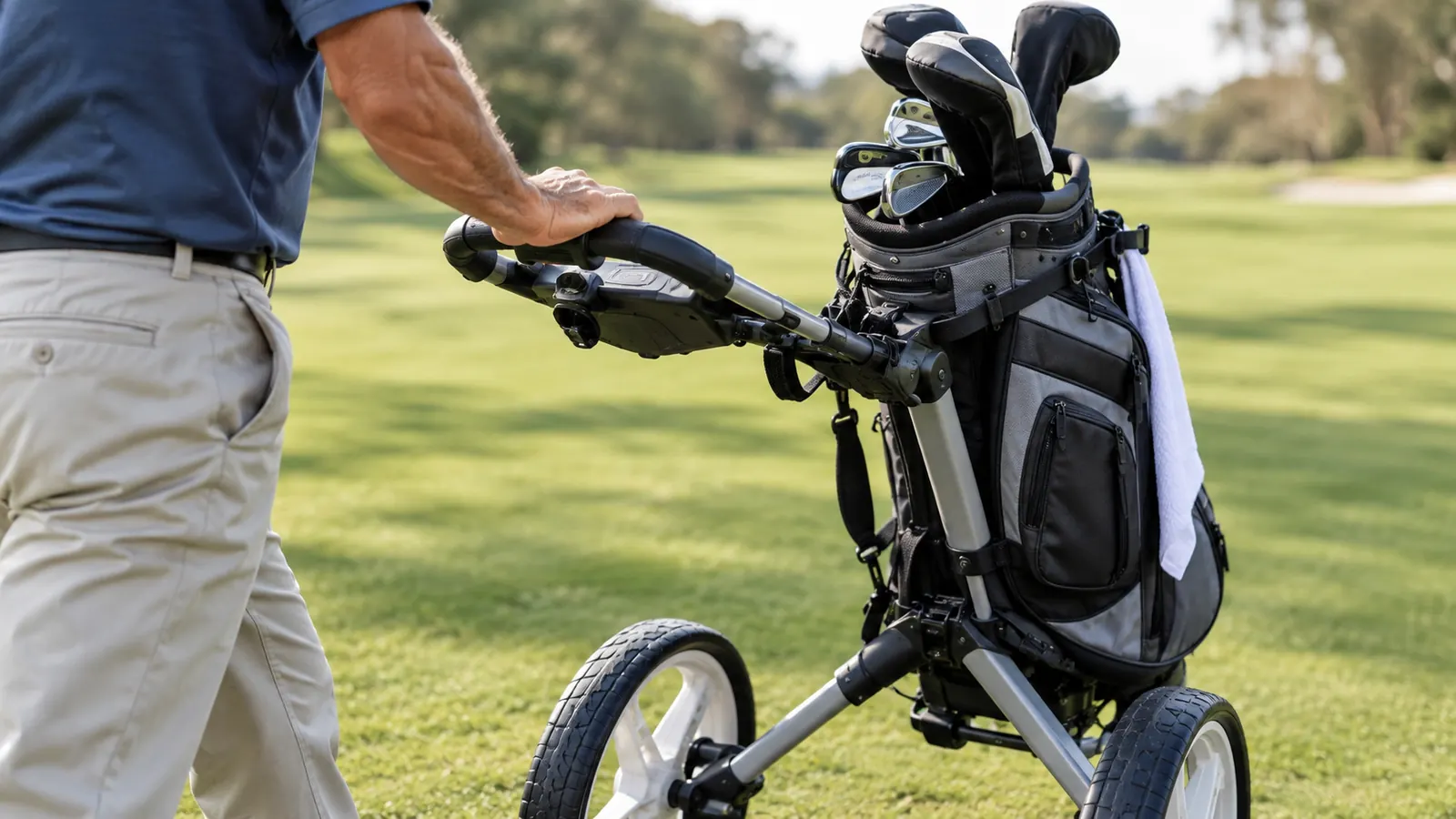
The CaddyLite also wins on hills, and Albuquerque courses have their share. Pushing a cart uphill is far easier on my lower back than carrying one, and the foot brake is not a gimmick. On a sidehill lie I set the brake, the cart stays put, and I can take my stance without holding the bag with one hand. The three EVA wheels track well on cart paths and through rough, and they are wide enough that they do not sink into wet fairways on the mornings after a rain. The handle adjusts so I am not bent over or reaching, and the mesh net and drink holder mean I am not twisting around to dig in my bag for water. I set the handle at chest height and walk with a normal stride. The umbrella holder has also saved me on the two or three afternoons a year when the desert sun gets serious, and it does not get in the way of my swing.
Where Carrying Your Bag Wins
I will not pretend carrying has no upside, because it does. It is better exercise. Carrying twenty-five to thirty pounds for five miles builds shoulder strength, works your core, and burns more calories than pushing a cart. If your back is healthy and your doctor is happy with you carrying, I am not going to talk you out of it. There is a reason the younger players on my course still carry. It keeps them fit in a way that pushing does not, and a few of them are honest enough to say they like the feel of the bag on their shoulder. I will also say this: carrying keeps you honest about how much weight you actually bring. A cart can hide a bag that has collected three extra sweaters and a dozen old balls.
Carrying is also simpler in the logistics department. There is nothing to fold, nothing to strap down, and nothing extra to load into the truck. You grab the bag and walk out the door. It also means one less thing to worry about if you are the kind of player who likes to be out of the parking lot and on the tee in ten minutes. The CaddyLite folds flat and takes very little room in my older pickup, but it is still one more thing to handle before and after the round. For a golfer with a healthy back, carrying can feel like part of the ritual of the game, the way the first tee always smells like cut grass and sunscreen. I understand that, because I miss parts of it. I do not miss the morning after. That trade, ritual for recovery, is one I made willingly and would make again.
If your back is the reason you are thinking about a cart, this is the one I walk with
The Caddytek CaddyLite takes the bag weight off your spine, folds flat for the ride to the course, and has held up through a full season of my walking rounds. Check today's price and see if it fits how you play.
Amazon Check Today's Price on Amazon →
Who Should Buy Which
Buy the Caddytek CaddyLite if your back is the thing standing between you and another round. If a doctor has told you that you have a bulging disc, or you simply notice that your lower back is stiff the morning after you carry, taking the weight off your spine is the most direct change I found. You still walk every step of the 18. You just do not carry it. I would also buy it if your course has real hills, because that is where carrying hurt me most and where the cart helped most. And buy it before the season wears you down, not after you have already spent a month hurting on the back nine. The cart paid for itself in the sense that matters to me: I am still playing, and I am still walking.
Keep carrying if your back is fine and your doctor sees no reason to stop. You get a better workout and you skip the extra gear. And if your pain is sharp, or it runs down your leg, do not take my word for any of this. I am a retired land surveyor, not a doctor or a physical therapist. What I can tell you is what helped me keep playing at 61. What I cannot do is tell you what is going on inside your own back. That is a conversation for someone who has studied backs. If you are early in your own back trouble, that conversation is worth having before you spend money on any gear, mine included.
What the CaddyLite Is Like to Live With
The CaddyLite is a three-wheel cart with a quad-fold frame, which is a fancy way of saying it folds down to something small enough to fit behind the seat of my pickup. It takes me about fifteen seconds to open it and the same to close it, and I can do it without taking off my hat. The handle adjusts to my height, the foot brake locks the rear wheel on a slope, and the EVA wheels roll quietly over cart paths without bouncing the bag around. The mesh net under the handle is where I keep my rangefinder and a spare glove, and the drink holder actually holds a water bottle through a full round.
None of that matters as much as the thing it does to my round. Because the cart takes the weight, I walk differently. I stand straighter, I breathe easier, and I have more left for the swing on the last few holes. The best compliment I can give it is that I stopped noticing it by the third hole. It just became the way I walk. That is what you want from a piece of gear: it disappears and lets you play. The only time I notice it is when I lock the brake on a hill, and even that takes half a second.
The Honest Limit of What a Cart Can Do
I do not want to oversell this. The CaddyLite helped my back, but it did not make my back young again. I still get stiff if I sit in the truck for two hours to reach a course. I still warm up slowly, and I still have rounds where my lower back talks to me on the back nine. What the cart did was remove one clear source of strain, the one I could control. That was enough to keep me walking 18 holes two or three times a week, and at my age that counts as a win. I will take that trade any day.
The other thing I would tell you is to watch how you push. A cart only helps if you walk tall with a relaxed grip and the handle at the right height. If you hunch over the handlebar, you trade one bad posture for another. Set the handle so your arms hang naturally, keep your shoulders back, and let the cart roll. And if anything hurts in a sharp way, or the pain moves into your leg, stop guessing and go see someone who knows backs.
The cart did not make my back young again. It removed the one source of strain I could control, and that was enough to keep me walking.
Keep walking the course, just stop carrying the weight
The Caddytek CaddyLite is the cart I have walked with all season, and it folds flat enough to live behind the seat of my pickup. Check today's price on Amazon and compare it against another season of morning stiffness.
Amazon Check Today's Price on Amazon →