
I bought the Mebak 3 about eight months ago, and I can tell you exactly what the product page does not tell you. It does not tell you that the first time you press it against a knot in your lower back, you will flinch. It does not tell you that you will spend the first week guessing which attachment actually does something. And it does not tell you that after a few months, you will reach for it on autopilot the way you reach for your car keys. I am Warren, 61, a retired land surveyor in Albuquerque, and I have played golf two or three times a week for most of my adult life. My lower back has been stiff for about ten years, and a doctor told me at 52 that I had a bulging disc. This is the honest version of what owning a Mebak 3 has been like.
The Quick Verdict
The Mebak 3 is the most useful recovery tool I own, but it took a week of fiddling to learn how to use it properly, and it will not fix a back that needs a doctor.
Amazon Check Today's Price →The massage gun I reach for after every round
If your back is stiff after 18 holes and you want something that actually gets used, this is the one I keep on the kitchen counter. Check today's price on Amazon.
Amazon Check Today's Price on Amazon →How I've Used It
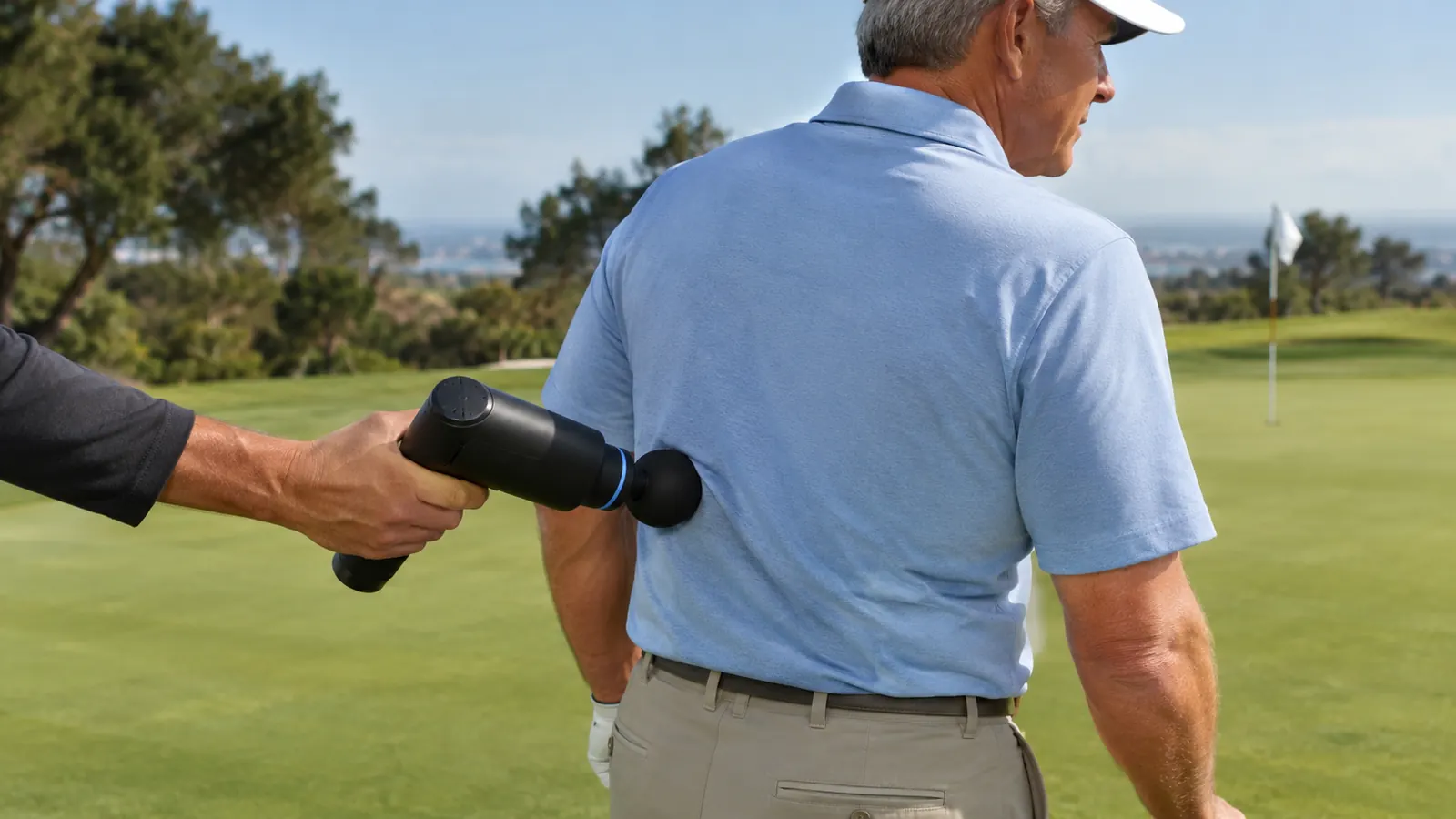
I have used the Mebak 3 after every round I have played since last September, which works out to roughly 50 rounds. I have also used it on the mornings when I wake up and my lower back feels like a board. My routine is simple: after I get home from the course, I sit on the edge of the bed or on a kitchen chair, and I work on my lower back for about ten minutes. I use the ball attachment for the big muscles on either side of my spine, and the flat attachment for my glutes. I do not use it directly on my spine, because that seems like a bad idea, and I do not use it on sharp pain, because my doctor told me not to.
The first week was not love at first sight. The gun is heavier than it looks in the photos, and the vibration feels strange when you first press it against a sore spot. I also made the beginner mistake of using the highest speed right away, which left me more sore the next morning than the round itself did. It took me about a week to learn that the lower speeds do the real work, and that ten minutes of steady pressure beats twenty minutes of jabbing at yourself.
I should say plainly that I am not a doctor or a physical therapist. I am a retired land surveyor who has had a stiff lower back for a decade. If you have pain that is sharp, radiating down a leg, or getting worse, talk to your own doctor or PT before you buy anything. The Mebak 3 is a tool for muscle stiffness, not a treatment for a back problem.
What Nobody Tells You About the Mebak 3
The product page makes the Mebak 3 look like a magic fix that will have you swinging like you are 30 again. It is not that, and I would rather tell you the truth. What it actually does is make the stiffness go from a 7 to a 3 on the mornings after a round. That is worth a lot to me, but it is not the same as a cure.
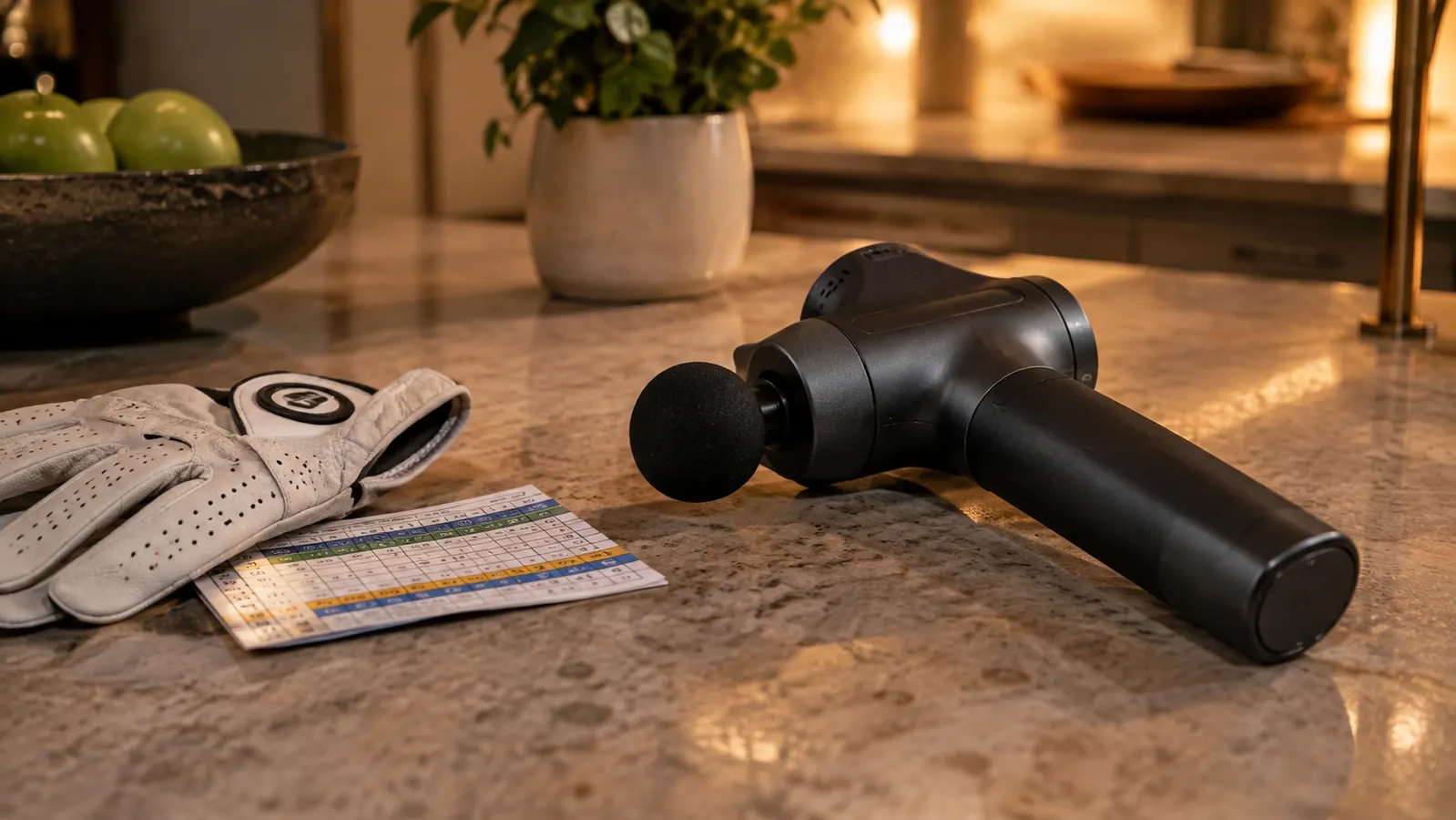
Nobody tells you that the battery lasts longer than you expect. I charge it about once every two weeks, even with daily use. Nobody tells you that the carrying case is actually useful, because you will not use it. The gun lives on my kitchen counter, not in the case. Nobody tells you that the noise level is noticeable. It is not loud, but it is not quiet either. If you use it while your wife is watching television, she will look at you.
The biggest thing nobody tells you is that the Mebak 3 will not fix the reason your back is stiff. If you have a bulging disc like I do, the gun is a way to manage the muscle tightness around it. It does not change the disc. It does not make the underlying problem go away. What it does is make the next morning more bearable, and for a 61-year-old golfer who wants to keep playing, that is enough.
The Mebak 3 does not fix the reason my back is stiff. It makes the morning after a round go from a 7 to a 3, and for a 61-year-old golfer, that is enough.
The Attachments and What They Actually Do
The Mebak 3 comes with several attachments, and I have used all of them enough to have an opinion. The ball attachment is the one I use most, because it covers a wide area and does not dig in too hard. The flat attachment is good for glutes and for the top of the shoulders. The bullet attachment is the one I was most excited about and the one I use least, because it is too intense for my lower back. The fork attachment is for either side of the spine, and I use it sparingly, because it is easy to overdo it.
My advice is to start with the ball attachment and the lowest speed, and to spend a few sessions just learning what your back tolerates. The Mebak 3 has enough power to do real damage if you use it carelessly, and I say that as someone who spent one miserable morning proving it. Respect the tool and it will respect you.
How It Compares to the Other Things I Tried
Before the Mebak 3, I tried a foam roller, a heating pad, and a cheap percussion massager that died after three months. The foam roller helped, but it was hard to use on my lower back by myself, and it took more effort than I wanted to put in after a round. The heating pad felt good in the moment but did nothing for the next morning. The cheap massager was fine until it was not, and it did not have enough power to get into the deep muscles.
The Mebak 3 is the first thing that combines enough power with enough control. I can use it on the lowest setting for a gentle warm-up, or I can step it up when my glutes are really tight. It is not a replacement for stretching, and I still do my stretches before I play. But it has replaced the foam roller for the days when I need something that actually gets into the muscle.
The Battery, the Noise, and the Build
The battery life is genuinely impressive. I use the Mebak 3 for about ten minutes a day, and I charge it every two weeks or so. The noise level is moderate. It is quieter than the cheap massager I had before, but it is not silent, and it has a distinct buzz that carries through a room. The build quality feels solid. The gun has survived eight months of daily use, including one drop onto a tile floor, and it still works like the day I bought it.
The one thing I would change is the case. It is a nice case, but it is bulky, and I never use it. I would rather have a simpler sleeve that takes up less space. That is a small complaint, and it does not change how I feel about the gun itself.
What a Week Looks Like With the Mebak 3
I play two or three rounds a week, so my back is rarely fully rested. On a playing day, I use the Mebak 3 for about ten minutes when I get home: lowest speed, round head, on the muscles beside my lower spine and then on my hips and glutes. On the morning after a round, I do a shorter five minute pass before I get moving. On rest days I usually skip it, unless I spent the day doing yard work, which my back treats like a fourth round.
The pattern I noticed after a couple of months is that the Mebak 3 matters most when I use it consistently, not when I wait for a bad day. When I skipped it for a week during a cold snap, the stiffness after my next round was noticeably worse and lasted longer into the next morning. When I stuck with the routine, my first few holes felt looser and I did not spend the drive to the course dreading the first tee shot.
I also learned to keep it away from the spine itself, from the back of the neck, and from anything that is bruised or swollen. The muscles are the target. The bones are not. If you have a medical condition, a recent injury, or pain that runs down your leg, talk to your doctor before you put any percussion device on your back. I did, and my doctor told me what I expected to hear: fine on the muscles, gentle, and stop if anything feels sharp.
Things I Wish I Had Known Before I Ordered It
First, the highest speeds are not for a sore lower back. They are for big leg muscles on young athletes. I have used the top setting exactly twice, both times by accident. The bottom two settings are where I live. If you buy the Mebak 3 expecting to use every speed, you will probably end up using two of them, and that is fine.
Second, the attachments matter more than the speeds. The round ball is my everyday head. The flat head is better on the glutes. The fork head that goes on either side of the spine sounds like it was made for golfers with a bad back, but I found it too pointed for my taste and I keep it in the case. Your mileage may vary, so try each one on low before you decide.
Third, it is not silent. It is quieter than I expected, quiet enough to use while Linda watches television in the same room, but you will hear it. And fourth, the battery lasts longer than I need. I charge it about once a week with my routine. I have never had it die in the middle of a session, which is more than I can say for my old golf cart battery.
Last, and this is the honest part: the Mebak 3 does not change what is going on inside your back. It loosens the muscles around it so you can move more comfortably. For me, that difference is enough to keep playing three times a week, which is the whole point.
One more thing nobody mentions: it helps to have a second pair of hands. The lower back is an awkward place to reach on your own, especially when it is already stiff. I can do a decent job by myself sitting forward in a kitchen chair, but on bad days Linda runs the Mebak 3 over the muscles beside my spine while I lie on the couch. She keeps it on the lowest speed and moves it slowly, and those sessions do more for me than anything I manage alone. If you live with someone who is willing, show them where the muscles are and where the spine is, and let them help.
And give it a fair trial. The first two or three sessions felt strange to me, almost too buzzy, and I nearly put it back in the box. By the second week I was looking forward to it. Most of the people I play with who bought one and gave up did it in the first few days. The ones who kept going for a month are still using theirs.
What I Liked
- Low speeds are gentle enough for a stiff lower back after 18 holes
- Round and flat heads cover the lower back, hips and glutes well
- Quiet enough to use in the same room as the television
- Battery easily lasts a week of daily ten minute sessions
- Small enough to keep on the kitchen counter where you will actually use it
Where It Falls Short
- The top speeds are more than most sore backs need
- The fork head is too pointed for some people
- It is not silent, just quieter than most
- It loosens muscles, it does not fix what is going on in your spine
Who This Is For
The Mebak 3 is for the golfer who has a stiff lower back after a round and wants something that actually gets used. It is for the person who has tried a foam roller and found it too much work, or a heating pad and found it too temporary. It is for the person who wants a tool that lives on the kitchen counter and gets used every day, not a gadget that sits in a drawer.
Who Should Skip It
Skip the Mebak 3 if you have sharp pain, pain that radiates down your leg, or a back problem that your doctor has told you to be careful with. Skip it if you are looking for a cure for a bulging disc, because this is not that. And skip it if you are not willing to spend a week learning how to use it, because the first few sessions will not feel like magic. It is a tool, not a fix.
The one recovery tool I actually use every week
If you are tired of foam rollers that take too much effort and heating pads that only work while they are on, the Mebak 3 is worth a look. Check today's price on Amazon.
Amazon Check Today's Price on Amazon →