
The morning after 18 holes used to be the worst part of golf for me. I would wake up, swing my legs out of bed, and feel that familiar grab in my lower back. By the time I got to the first tee the next week, I was already thinking about how I would feel on the drive home. I am Warren Oakes, 61, a retired land surveyor in Albuquerque, and I have played this municipal course two or three times a week for years. A doctor told me at 52 that I had a bulging disc in my lower back and that staying active was the plan. So I stayed active, and I also spent a lot of mornings stiff. That is why I bought the Mebak 3 massage gun, and why I have used it almost daily for the better part of a year.
This is not a medical review and I am not a doctor or a physical therapist. This is one golfer's long-term report on a tool that has genuinely changed my recovery routine. If your back pain is sharp, radiating, or getting worse, talk to your own doctor or PT before you buy anything. What follows is what the Mebak 3 did for me, what it did not do, and who I think should skip it.
The Quick Verdict
The Mebak 3 is the first massage gun I have owned that I actually reach for after every round. It is not a cure for a bulging disc and it will not fix a bad swing, but for ordinary golf-related stiffness it has been worth every penny of the current price.
Amazon Check Today's Price →The massage gun I reach for after every round
After months of daily use, the Mebak 3 is still the first thing I grab when my lower back tightens up. Check today's price on Amazon and see if it fits your routine.
Amazon Check Today's Price on Amazon →How I've Used It
I have used the Mebak 3 nearly every day for about ten months. On golf days, I use it twice: once in the evening after I get home from the course, and once the next morning before coffee. On days I do not play, I usually use it once, mostly on my lower back and sometimes on my shoulders after I have been hunched over a transit all day.
My routine is simple. I start with the lowest speed and the round ball attachment, and I work along the muscles beside my spine, not directly on the spine itself. I spend maybe two minutes per side. If a spot feels especially tight, I hold the gun there for thirty to forty-five seconds at a medium speed. I do not use the highest speed on my lower back; it is too much for me there. On my shoulders and the back of my legs, the higher speeds are fine.
The battery has been a pleasant surprise. I charge it about once every two weeks with my normal routine, and I have never had it die mid-session. The handle is comfortable enough to hold for the ten or twelve minutes I typically use it, and the controls are simple enough that I do not need to look at them. That matters when I am using it on my own lower back and cannot see the buttons.

What the Mebak 3 Actually Does for a Stiff Lower Back
The honest version is this: the Mebak 3 does not fix my back. It does not make the bulging disc go away, and it does not guarantee I will wake up pain-free. What it does is take the edge off the stiffness so I can move better, and it does that more consistently than anything else I have tried.
The difference shows up most clearly in the morning. Before I had the Mebak 3, the first few steps after getting out of bed were slow and careful. Now, after using the gun the night before, those first steps are still a little stiff, but noticeably less so. It is the difference between starting my day moving carefully and starting my day moving normally. For a 61-year-old who wants to keep playing 18 holes two or three times a week, that is a real improvement.
I have also noticed that my warm-up on the course is easier. I still do my usual stretching before I tee off, but I do not feel as tight during the first few holes. I cannot prove the gun is responsible, and I would not claim it is. But the change came after I added it to my routine, and it has stayed.
The Attachments and Speeds I Actually Use
The Mebak 3 comes with several attachments, and I have settled into three of them. The round ball is my default for the lower back. The flat head I use on my shoulders and the backs of my legs, where the round ball feels too pointed. The fork attachment I use sparingly, mostly along the sides of my spine, and only at low speed.
The speed range is wide enough for me. The low end is gentle enough for the sensitive spots around my lower back, and the high end is strong enough that I rarely need it. I have used other massage guns that felt either too weak at every setting or too aggressive at every setting. The Mebak 3 has a usable range, which is the thing I care about most.
One note: the gun is not quiet. It is not the loudest tool I have used, but it is not something I would run in a quiet room while someone else is trying to watch television. I usually use it in the garage or the bedroom with the door closed. Linda, my wife, has gotten used to it, but she still calls it the jackhammer.
How It Compares to What I Tried Before
Before the Mebak 3, I tried a foam roller, a lacrosse ball, and a cheaper massage gun that I returned after two weeks. The foam roller helped my legs but never seemed to reach the deep spots in my lower back. The lacrosse ball worked for specific trigger points but required me to lie on the floor in awkward positions, which my back did not always appreciate.
The cheaper gun was the most useful comparison. It had only two speeds, and the low speed was still too aggressive for my lower back. The Mebak 3's low speed is genuinely gentle, which is the main reason I kept it. The build quality also feels better. After ten months of near-daily use, the Mebak 3 still works like it did on day one. The cheaper gun started rattling within a month.
I have also used a friend's high-end massage gun at the course. It was stronger and quieter, but it cost several times what the Mebak 3 costs, and I did not feel the difference was worth it for my needs. For a recreational golfer with ordinary stiffness, the Mebak 3 sits in a practical middle ground.
What I Liked
- Genuinely gentle low speed, which is the difference between usable and unusable for a sensitive lower back
- Battery lasts about two weeks with my daily routine
- Simple controls I can operate without looking
- Held up well over ten months of near-daily use
- Comes with enough attachments to cover the spots I actually need
Where It Falls Short
- Noticeably loud, so I use it in a separate room
- The highest speeds are more than I need on my lower back
- No carrying case included, which would have been nice for the golf bag
- It is a tool, not a treatment; it does not replace stretching, walking, or seeing a doctor
The Mebak 3 does not fix my back. It takes the edge off the stiffness so I can move better, and it does that more consistently than anything else I have tried.
The Long-Term Test: Ten Months In
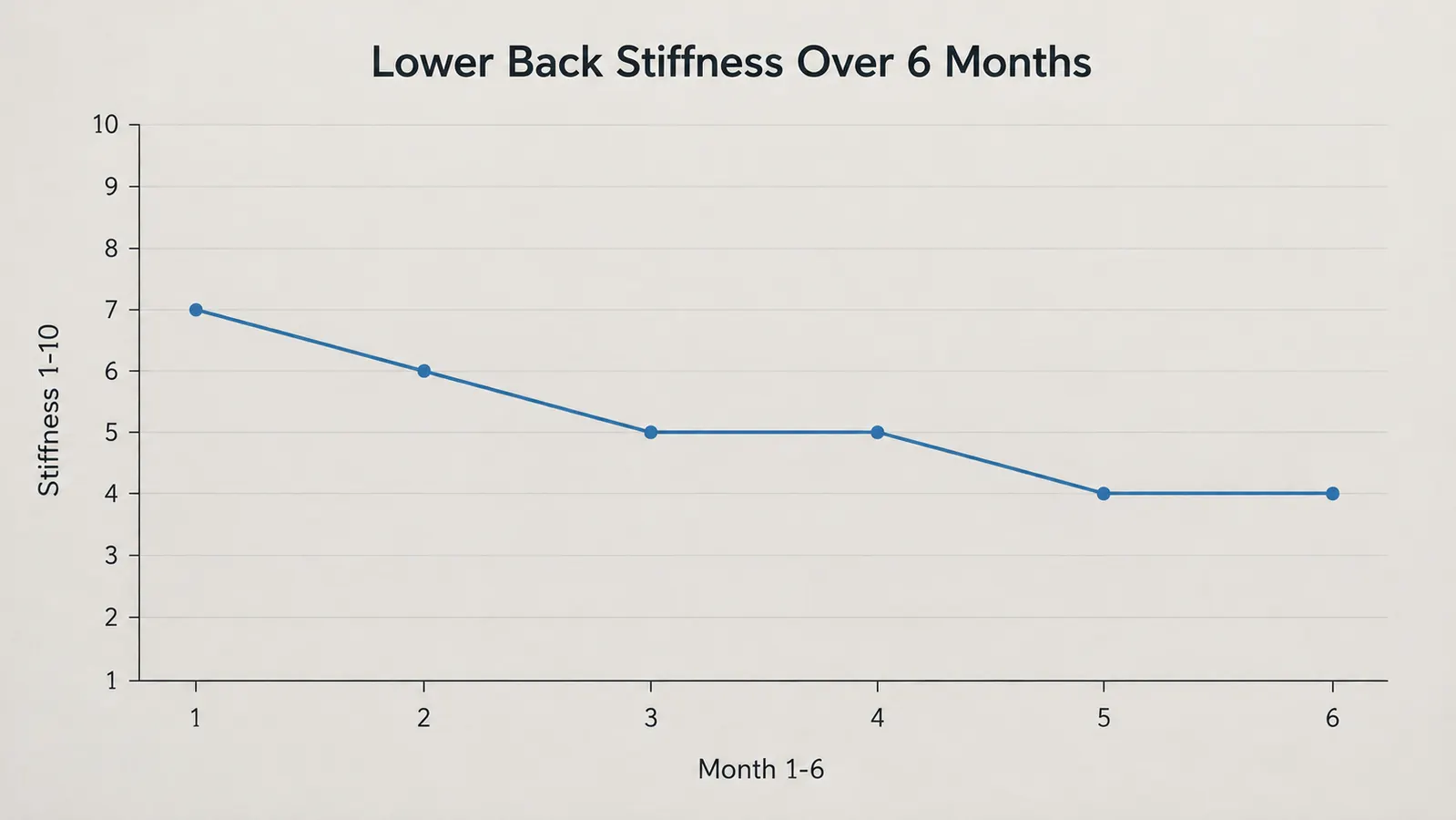
The question I get most often from playing partners is whether the Mebak 3 still works after months of use. The answer is yes, with one caveat. The gun itself works exactly as it did on day one. The battery holds a charge, the attachments stay put, and the motor has not changed. The caveat is that I have learned to use it better. I no longer chase every tight spot at high speed. I use the low and medium settings, I spend more time on the areas that actually bother me, and I stop when I have had enough.
I have also learned what it cannot do. It cannot undo a day of poor posture on the course or a long drive in my pickup truck. If I sit for three hours on the way to a tournament, the Mebak 3 helps, but it does not erase the drive. I have to pair it with getting out of the truck, walking around, and stretching before I play. The gun is part of the routine, not the whole routine.
The other long-term observation is that I use it more than I expected. I bought it for golf recovery, but I now use it after yard work, after long days in the field, and on the mornings when I wake up stiff for no obvious reason. It has become the tool I reach for first, and it has earned that place.
My After-Round Routine With the Mebak 3, Minute by Minute
When I get home from the course, the Mebak 3 comes out before I even take my shoes off. I sit on the edge of a kitchen chair, lean forward a little, and start on the lowest speed with the round ball head. I spend about two minutes on the big muscles on the left side of my lower back, staying well off the spine itself, then two minutes on the right. I keep the gun moving slowly, like I am painting a wall, instead of pressing it into one spot.
After that I switch to the flat head and work the glutes and the outside of the hips for another two or three minutes. That was the part I skipped for the first few weeks, and it turned out to matter more than the lower back itself. A tight hip pulls on everything above it, and after 18 holes of turning my body against the ball my hips are usually the tightest thing I own. I finish with a minute on each hamstring while sitting back in the chair.
The whole routine runs about ten minutes. I do it again for five minutes the next morning before coffee if the round was hilly or if I played two days in a row. That second session is the one that has made the biggest difference in how I feel getting out of bed. I keep the Mebak 3 on the counter by the coffee maker for exactly that reason. If it is in a drawer, I forget it, and if I forget it, I feel it.
Who This Is For
The Mebak 3 is for the recreational golfer who deals with ordinary lower back stiffness and wants something that actually gets used. If you play 18 holes, feel tight the next morning, and have been considering a massage gun but worried it would end up in a closet, this is a reasonable place to start. The gentle low speed makes it usable for people who are sensitive to deep pressure, and the battery life means you are not constantly charging it.
It is also for people who, like me, are not looking for a cure. If you understand that a massage gun is a recovery tool and not a medical treatment, you will probably be satisfied with what the Mebak 3 does. It takes the edge off stiffness, helps me move better in the morning, and has held up for ten months. That is what I bought it for, and that is what it delivers.
Who Should Skip It
Skip the Mebak 3 if your back pain is sharp, radiating, or getting worse. No massage gun is a substitute for a doctor's opinion, and I would not want anyone to delay getting real medical advice because they bought a tool. If you have a diagnosed condition and your doctor or PT has not cleared you for percussion therapy, talk to them first.
Skip it if you need something quiet. The Mebak 3 is not the loudest massage gun I have used, but it is loud enough that I do not use it in the living room while Linda is reading. If quiet operation is a priority, you will want to look at higher-end models. And skip it if you expect a massage gun to fix your swing or eliminate your back problems. It will not do either, and no honest review should suggest otherwise.
Still the first thing I grab after a round
Ten months in, the Mebak 3 is still part of my routine after every round and every stiff morning. If you are tired of waking up sore the day after golf, check today's price on Amazon.
Amazon Check Today's Price on Amazon →