The part of golf that hurts me most isn't the three-putt on 17 or the shank into the desert rough on 9. It's the 4 AM wake-up the next morning, when my lower back has tightened into something that objects to every move I make just swinging my legs out of bed.
I'm Warren Oakes. Sixty-one years old, retired land surveyor, live in Albuquerque, New Mexico. I play 18 holes two or three times a week at the municipal course, walk with a push cart when I can, and carry a 14 handicap. I've had lower back stiffness for about ten years. At 52, a doctor told me I had a bulging disc in my lower back. His advice: stay active, keep my core strong, and don't let the stiffness turn me into a man who stops moving. The Mebak 3 massage gun is part of how I do that.
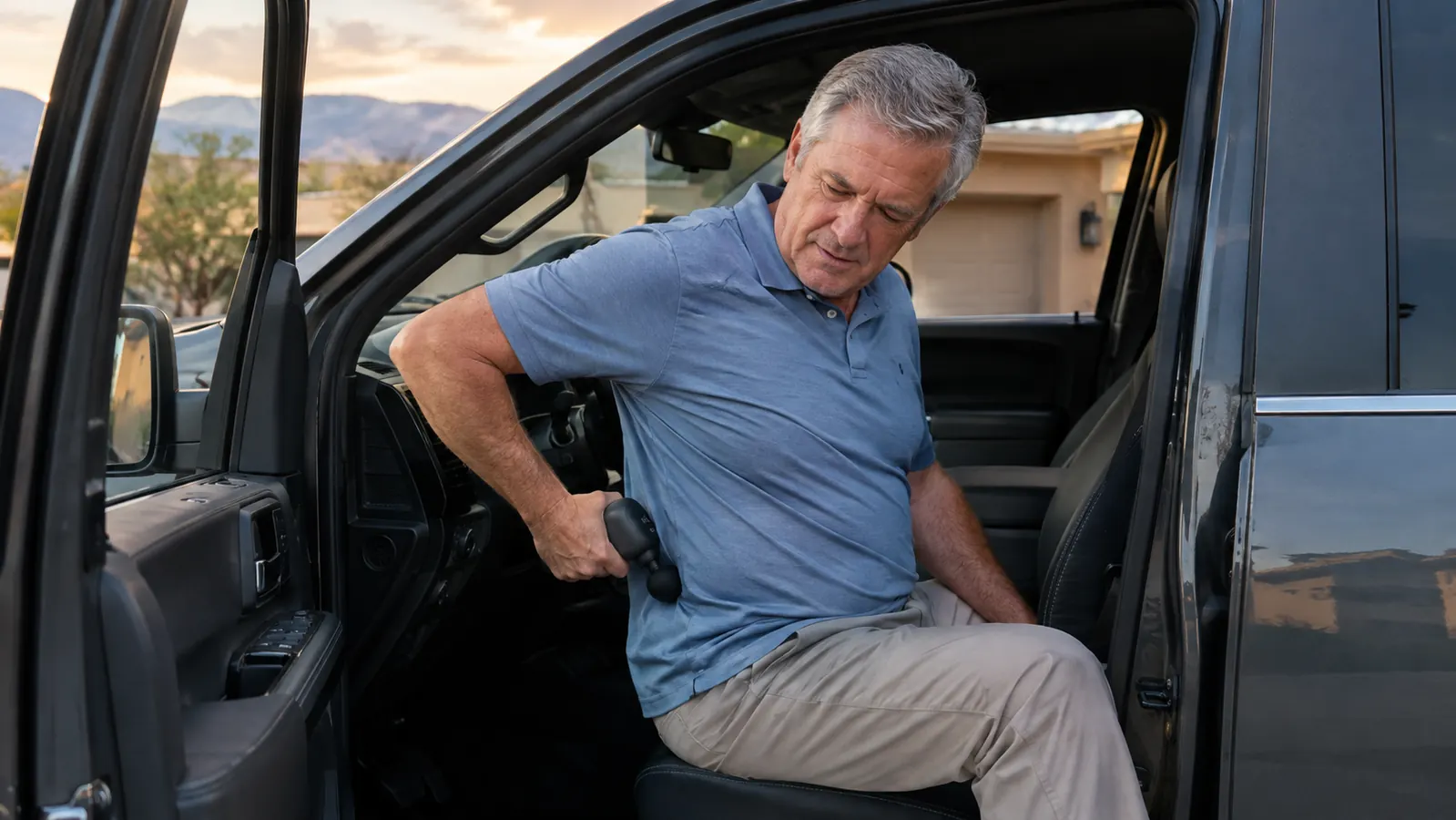
Here's the part I didn't expect: the stiffness doesn't show up on the course. It shows up after, when I'm loading the clubs into my pickup, on the drive home, or sitting in the living room with dinner on my lap. Then it waits until some ungodly hour of the night to announce itself. And when it does, the sleep is gone and I'm awake counting the hours until I can get up and move.
So I put together a routine with the Mebak 3 that gets me through the round and through the next day. I'm not a doctor and I'm not a physical therapist. I'm a retired land surveyor who found a sequence that works for me. If your pain is sharp, or it radiates down a leg, or it's getting worse, talk to your own doctor or PT before you do any of this.
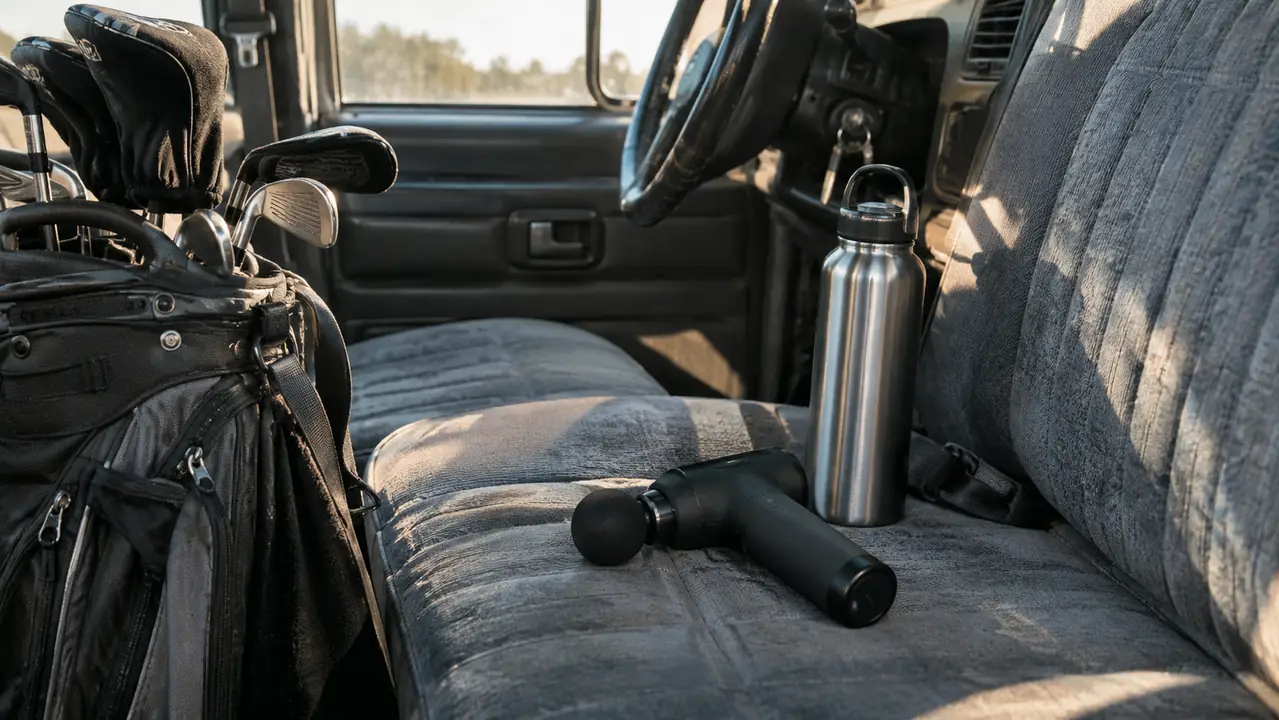
The Mebak 3 rides in my truck for exactly this reason
It's where I can reach it before my back settles after the drive home. Check today's price on Amazon.
Amazon Check Today's Price on Amazon →Step 1: Do the first pass in the parking lot
The moment the round ends, my back starts a countdown. As soon as I stop walking with the push cart and the adrenaline of the last hole wears off, the muscles that held me upright for four hours begin to tighten. By the time I've loaded my clubs into the pickup and driven the twenty minutes home, that tightness has usually turned into a dull ache across my lower back. So I changed the order of things. The Mebak 3 stays in the truck, in the little cubby behind the seat. When I pull into the driveway, I don't grab the golf bag first. I grab the gun.
With the door open and one foot on the ground, I spend five minutes at the lowest speed on the muscle bands that run alongside my spine. Not on the spine itself, never on the spine. Low and slow, moving the head maybe two inches per second. It isn't a massage spa experience. It's maintenance, the same way I check the oil in the truck before a long drive. Thirty seconds of attention in the driveway does more for me than half an hour on the couch later, because the stiffness hasn't had time to set up camp.
I keep the pressure light. The goal on this first pass is to tell the muscles that the work is done and they can stand down, not to beat them into submission. Five minutes, low speed, done. Then I grab the bag and head inside. I learned this the hard way too: the first time I tried it, I used the middle speed and went too long, and I was worse off than if I'd done nothing at all.
Step 2: Work the glutes before you touch your back
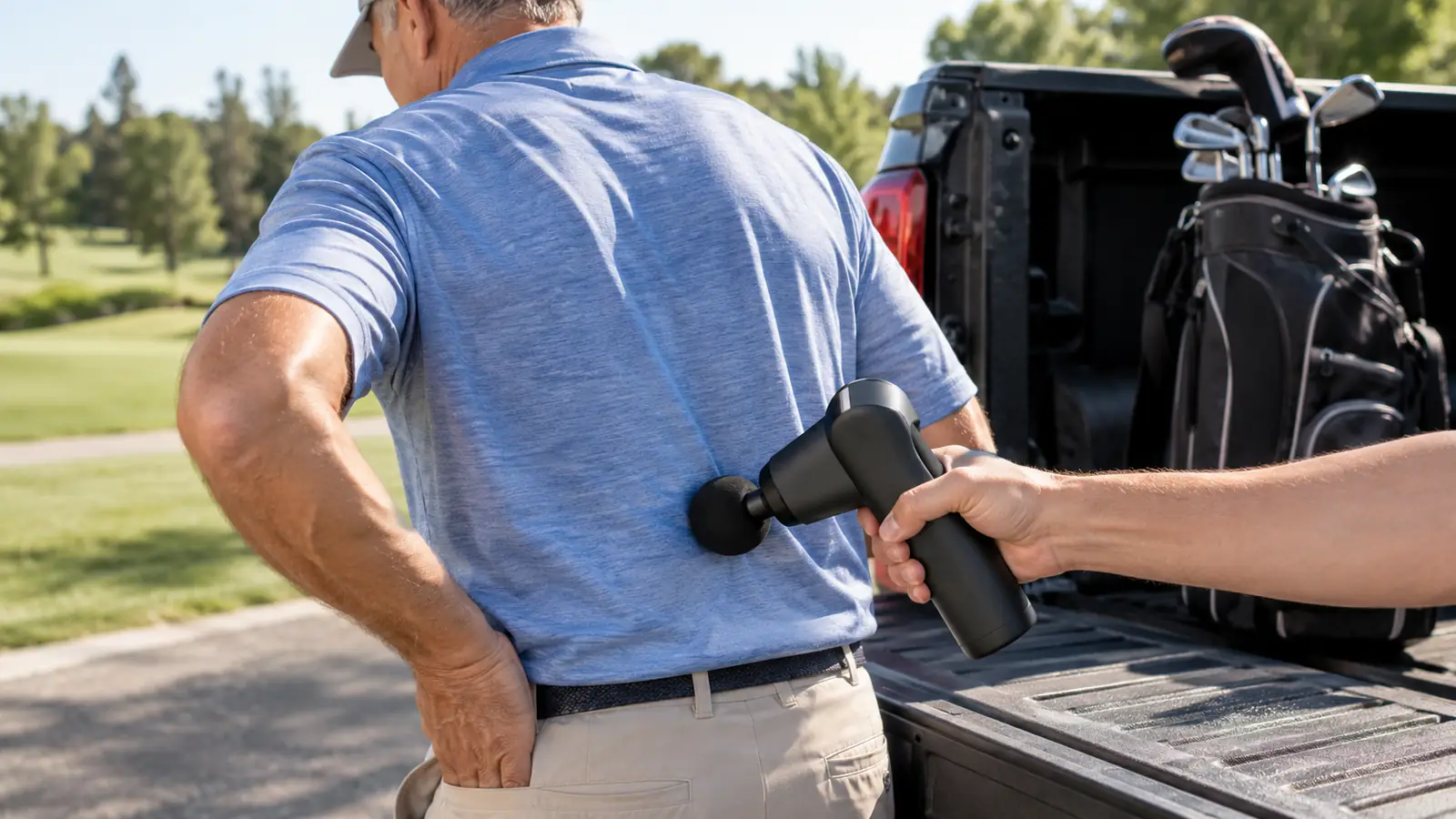
The biggest change in how I treat my lower back came when I stopped aiming at the spot that hurt. Most of the load of a golf swing lands in the glutes. They take the force of the turn and the drive off the back foot. When they get tight, they pull on the whole chain, and my lower back is where I notice it first. For the first few years of my back trouble, I did the opposite of what I do now: I went straight at the sore spot with whatever I had on hand. Nothing stuck.
Now the Mebak 3 touches my glutes first, at a medium speed, before it goes anywhere near my lower back. Two minutes per side, moving the head in slow circles over the meaty part of the muscle, not digging in hard but keeping steady contact. Then I move up. It sounds like a small change in order, but it changed the outcome for me. When the glutes are loose, the lower back doesn't have to do the compensating work overnight. That's the difference between waking up stiff and waking up sore but mobile.
I use the flat head for this part, the one that spreads the contact over a bigger area. It covers ground faster and it's harder to overshoot into a painful spot. My physical therapist once told me that tight glutes are the most common reason her golf patients end up in her office. I believe her now.
Step 3: Keep the speeds low on the lower back
The Mebak 3 has several speed settings, and the top end of the range has real power. I use the upper speeds on my thighs and the thick part of my glutes, and they feel great there. On the lower back, I don't touch them. The low settings are for the back, full stop. High speeds near a sensitive part of my back leave me more tender the next day, not less. That's a lesson I only had to learn once.
Why does speed matter so much? My doctor explained it this way: the tissue around a bulging disc is already irritated. A hammering pulse at high speed is the last thing that tissue wants. What it wants is steady pressure that gets blood moving into the muscle so it can relax on its own. The low speeds on the Mebak 3 do that well. The head sitting in one place, slowly moving along the muscle band, produces a kind of calm that the high settings never give me. I think of it as the difference between tapping a sore bruise and holding a warm hand on it.
Two practical notes. First, move the gun, don't hold it in one spot over a bony area. Second, breathe. Sounds silly, but if I'm holding my breath while I work a tight spot, the muscle stays guarded. A slow exhale and the muscle lets go a little more. It's a minor thing, but it adds up over a season.
Step 4: Keep the whole session under ten minutes
This is the step I learned the hard way. After a round on a windy day, when my back had been working overtime against the breeze on every tee shot, I gave myself a full session one evening and then some. Twenty minutes with the Mebak 3, working my back and glutes twice over. It felt wonderful in the moment. Every tight spot I found, I went after it until it loosened. The next morning I paid for it.
The tissue was more tender than it had been before I started. I had hammered a part of my body that was already asking for rest. Since then, I set the timer on my phone before I pick up the gun. Two minutes per side on the glutes, two minutes per side on the lower back, and a final slow pass down each side. That works out to under ten minutes total. If the timer goes off and I still feel tight, I stop anyway. The session is the session.
More isn't better with a massage gun. The muscles need time to recover after being worked, and a lower back with a disc issue needs restraint more than it needs enthusiasm. If a spot stays angry for more than a couple of days, I go see my physical therapist. The gun is part of my routine, not the whole treatment. It works because everything else around it is boring and consistent. That consistency is what actually fixed my routine. Not a longer session, not a faster setting.
Step 5: Run a short version the next morning
The morning after a round used to be the worst part of golf for me. The stiffness would work on me overnight, and getting out of bed became an event I braced for, gripping the mattress and rotating my whole body like a log. The Mebak 3 changed that, but only because I use it at the right time. If I wait until after breakfast, when I've been sitting in a chair for half an hour, the window has closed. The routine has to happen before the stiffness wins the morning.
The morning version is short: about ninety seconds on each glute, another ninety seconds total on the lower back, everything on the low settings. No timer needed because it's quick enough to keep track of in my head. Just enough to get blood moving and remind the muscles the day has started. Then a slow stretch on each side, and I'm upright.
The order matters. I do the short session before I sit down with coffee or the paper. Once I'm settled in a chair, my back locks up again and it takes an hour to unhitch it. Three minutes with the gun in the morning, ten minutes the night before, and a round of golf stops being a thing I have to recover from. It's just a thing I did.
What Else Helps
The Mebak 3 is the tool I reach for first, but it's not the whole story. A massage gun works best when the rest of the day doesn't undo its work. A few things I do alongside the gun that have made a measurable difference.
A ten-minute walk after the round is non-negotiable for me. Not a cool-down stretch, just a slow lap around the parking lot or down the first block of the neighborhood. It gives the muscles a gentle way to come down from four hours of standing and swinging. The gun in the truck was the missing piece that made the walk enough. Without it, I'd cool down and then re-tighten on the drive home. I do the walk even when I'm tired. Especially when I'm tired, actually.
I drink more water on golf days than I used to. Dehydrated muscle tissue is cranky tissue, and I started noticing the stiffness getting worse on days when I skipped the water bottle. I aim for two full bottles over a round, not because a website told me to, but because I can feel the difference. Also, I get up from my desk every half hour. Sitting is the enemy of a lower back like mine.
And I stretch, but gently and late in the day, never cold. A few slow knee-to-chest pulls on the bed after the gun session, holding each for a count of twenty. That's it. I don't do dramatic stretches on the first tee, and I don't twist into shapes that make people at the range stare. My back has a decade of habits and it responds better to calm than to ambition.
The last thing in my routine is the most boring: checking the calendar. If I've played three days in a row, I take the fourth day off the course and go for a long walk instead. A massage gun can't manufacture rest, and my back tells me when it needs some. Listening to it beats any gadget on the shelf.
One night I gave myself a twenty-minute session and it felt wonderful. The next morning I paid for it. Ten minutes is my ceiling now.
The routine starts in the truck, before my back settles
That's why the Mebak 3 rides with me on golf days. Check today's price on Amazon.
Amazon Check Today's Price on Amazon →