
The front nine is easy. That is not a brag, it is just what my back does. I am Warren, 61, a retired land surveyor in Albuquerque, and I have played this municipal course two or three times a week for years. By the turn, I am loose, my swing feels like it belongs to me, and I am thinking about the scorecard instead of my body. Then comes the back nine, and somewhere around the 12th or 13th hole, my lower back starts to tighten up like it remembers it has a bulging disc from nine years ago. The stiffness does not usually turn into sharp pain, but it turns my swing into something I have to manage instead of something I enjoy.
I have tried a lot of answers over the years. Stretching on the tee box, ibuprofen at the turn, changing my swing to protect my back, which only made my swing worse. What has actually helped me finish rounds comfortably is a simple routine built around the MUELLER lumbar brace. I put it on before the round, I take it off before I drive home, and I do a few small things in between. None of it is complicated, and none of it is a cure. It is just a way to keep playing. If you have a stiff lower back that shows up late in a round, here is the exact routine I use.
Keep Your Back From Stealing the Last Six Holes
The MUELLER lumbar brace is the piece of gear I reach for before every round now. It supports the lower back without making me feel like I am wearing a suit of armor, and it comes off in seconds when the round is done.
Amazon Check Today's Price on Amazon →Step 1: Put the Brace On Before You Warm Up, Not After the Pain Starts
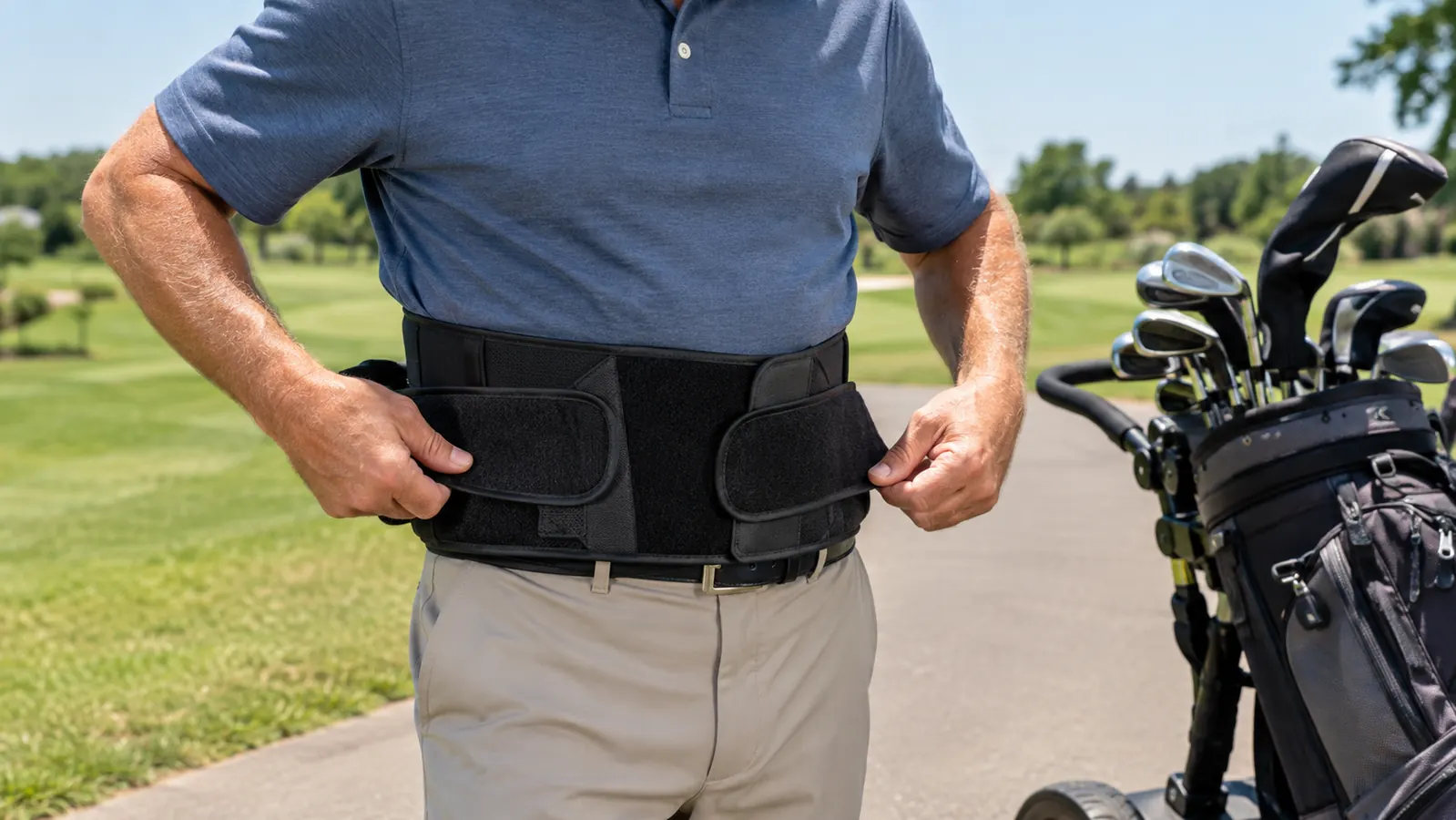
The biggest mistake I made for years was waiting until my back tightened up before I did anything about it. By the time the stiffness arrived on the 13th hole, I was already compensating, my posture was off, and the rest of the round was about survival. Now I put the MUELLER brace on at the car, before I even walk to the practice green. It takes about thirty seconds. The brace wraps around my lower back, the pad sits over the area that bothers me, and I pull the straps until it feels snug but not tight enough to restrict my breathing or my turn.
Wearing it during my warm-up matters more than I expected. When I stretch and hit practice balls with the brace on, my body gets used to moving with it from the first swing. There is no moment where I have to adjust my swing halfway through the round because something new is suddenly around my waist. The support is just there, doing its job, and I can forget about it until the back nine rolls around.
One note on fit: the MUELLER brace comes in sizes, and the package tells you how to measure your waist. I measured mine before I ordered, and the fit is what makes it comfortable enough to wear for four hours. If it is too loose, it bunches up when you bend. If it is too tight, you will want to rip it off by the third hole. Snug, not squeezing, is the goal.
Step 2: Walk the Course With a Push Cart, Not a Carry Bag
I used to carry my bag. I am 61, my back has a bulging disc, and I carried my bag anyway, because that is what I had always done. The turning point was a round where I could feel the stiffness building by the 9th hole, and I spent the back nine swinging like I was afraid of my own body. I bought a push cart, and it changed the math of the round completely. The brace supports my back during the swing, but the push cart keeps the load off my spine for the two and a half hours I am walking between shots.
If you already use a push cart, good. If you do not, I would not tell you to run out and buy one just for this. But I will tell you that the combination of the MUELLER brace and a push cart is what lets me walk 18 holes two or three times a week. The brace handles the twisting and bending. The cart handles the carrying. Together, they mean my back does not have to do either job alone.
When I do have to ride in a cart, I make a point of getting out and walking a few steps between shots. Sitting for five minutes between every swing tightens my back faster than anything. A little movement, even just walking to your ball, keeps the muscles from locking up.
Step 3: Use the Tee Box to Reset, Not Just to Hit
The tee box is where I do my reset. I am not talking about a full stretching routine in front of the group behind us. I am talking about ten seconds of the same movement I do at home: stand tall, put my hands on my hips, and gently lean back a few inches, then stand straight again. I do that once or twice while I am waiting to hit. It takes no time, it looks like I am just settling into the shot, and it keeps my lower back from settling into that stiff, locked feeling.
I also changed how I pick up the ball and the tee. I used to bend at the waist, which is exactly the movement that makes my back complain. Now I squat, keep my chest up, and use my legs. It feels like a small thing, but I do it forty or fifty times a round. Forty or fifty small bends done wrong will tighten any back. Done right, they do not even register.
The MUELLER brace helps here because it gives me feedback. When I start to slouch or bend badly, I can feel the brace resist the movement, and I correct myself without thinking about it. It is not doing the work for me. It is reminding me to do the work myself.

Step 4: Loosen the Brace at the Turn, Then Re-Snug It for the Back Nine
Here is something I figured out by accident. If I wear the brace at the same tightness for all 18 holes, it starts to feel like it is digging in by the 14th or 15th hole, and I get tempted to take it off. Now, at the turn, I loosen the straps just a little, let my back breathe for a few minutes while I eat a snack and drink some water, and then I re-snug it before I walk to the 10th tee. That two-minute reset makes the brace comfortable for the whole round instead of just the front nine.
The other thing I do at the turn is take a few slow walks around the parking lot or the clubhouse. Five minutes of easy movement, nothing strenuous, just enough to keep the muscles from cooling down and tightening up. Then I re-snug the brace and start the back nine feeling like I am starting a fresh round, not like I am halfway through a long one.
If you are someone who does not like to stop at the turn, I understand. But I would ask you to try it once. The ten minutes you spend resetting will save you from spending the last six holes fighting your own back.
Step 5: Take the Brace Off Before You Drive Home
This is the step I see people get wrong. They wear the brace all day, or they sleep in it, or they leave it on for the drive home because it feels supportive. I do none of that. The MUELLER brace is a tool for the round, not a permanent addition to my wardrobe. I take it off as soon as I am done, usually right at the tailgate of my pickup truck, before I get in to drive home.
Why does this matter? Because my back needs to do its own work. If I wear the brace for six hours after the round, my muscles lean on it, and the next morning I feel stiff in a different way, like my back forgot how to hold me up on its own. When I take it off right after golf, I give my back a chance to recover naturally. The brace helps me through the round. The recovery is my body's job.
The other part of the drive-home routine is the seat. I keep a small lumbar support cushion in my truck, and I use it on the drive home. The brace comes off, the cushion goes on, and my back gets a different kind of support for the thirty minutes I am sitting. That combination, brace on the course, cushion in the truck, is what gets me through the next morning without the stiffness I used to wake up with.
What Else Helps
The brace is the centerpiece of my routine, but it is not the whole routine. I do a few other things that have made a real difference. I stretch for five minutes the night before a round, focusing on my hamstrings and hips, because tight hamstrings pull on my lower back. I drink water through the round instead of just coffee, because dehydration makes everything stiffer. And I have learned to accept that some days my back is just not going to cooperate, and on those days I play nine instead of 18, or I take the week off. The brace helps me play more golf. It does not make me invincible, and I do not expect it to.
I also want to be clear about what this article is not. I am not a doctor or a physical therapist. I am a retired land surveyor who has lived with a bulging disc for about a decade, and I am telling you what works for me. If your back pain is sharp, or it radiates down your leg, or it is getting worse, please talk to your own doctor or PT before you try any of this. A brace is a support tool, not a treatment, and it should never be used to push through pain that your body is telling you to respect.
The brace handles the twisting and bending. The push cart handles the carrying. Together, they mean my back does not have to do either job alone.
The Brace I Reach for Before Every Round
The MUELLER lumbar brace is the one piece of gear that has consistently helped me finish the back nine without spending the next morning regretting it. It is not a cure, but it is a genuinely useful tool for golfers with a stiff lower back.
Amazon Check Today's Price on Amazon →