
The 16th hole is where I feel it. I bend over to pull the ball out of the cup, and my lower back says hello in a way that has nothing to do with friendship. By the time I load the push cart into the truck, I am already thinking about tomorrow morning, because that is when the real stiffness shows up. I am Warren, 61, a retired land surveyor in Albuquerque, and I have played golf two or three times a week for years. My back has been stiff for about a decade, and a doctor told me at 52 that I had a bulging disc in my lower back. His advice was simple: stay active, keep playing, and learn how to recover. This article is the routine I actually use after a long round, built around the TENS 7000 unit, and I want to be clear up front that I am not a doctor or a physical therapist. If your pain is sharp, radiating down a leg, or getting worse, talk to your own doctor or PT before you try anything I describe here.
I have owned the TENS 7000 for about a year and a half. It is the device I reach for on the evenings when a round has left my lower back tight and achy, and it is the device I reach for the next morning when I need to loosen up before I decide whether I can play again. It is not a cure. It does not fix a bulging disc. What it does is give me a way to take the edge off the soreness so I can sleep, move around the house, and get back on the course. Here is the step by step routine that works for me.
The TENS 7000 Is the Unit I Keep in the Bedroom for Stiff Back Evenings
After a long round, I want a device that is simple to set up, has enough power to actually feel like it is doing something, and does not cost a fortune. The TENS 7000 is the one I have used for over a year. Check today's price on Amazon and see if it fits your routine.
Amazon Check Today's Price on Amazon →Step 1: Give Yourself 20 Minutes Before You Do Anything
The worst thing I can do after a long round is walk in the door and immediately start bending, lifting, or stretching hard. My back has been in the same loaded position for four and a half hours, and it needs a minute to reset. So the first step of my routine is not the TENS 7000 at all. It is a glass of water, a few minutes of slow walking around the yard, and a shower. The warm water helps more than you would think, and it gives my back a chance to unload before I ask anything of it.
I also change into loose clothes. There is something about tight waistbands that makes a stiff lower back feel worse, and I have learned not to fight that. By the time I am sitting on the edge of the bed with the TENS 7000 in my hand, I have usually been home for about 20 minutes. That pause is part of the treatment. It is the difference between asking a tired muscle to work and letting it know it can relax.
One note: I do not ice my back after a round anymore. I tried it for years, and for me it made the stiffness worse the next morning. My PT explained that some backs respond better to warmth and gentle circulation than to cold, especially when the issue is muscle tightness rather than a fresh injury. If you have always used ice and it works for you, keep doing it. This is just what I found after a lot of trial and error.
Step 2: Place the Pads Where the Soreness Actually Is
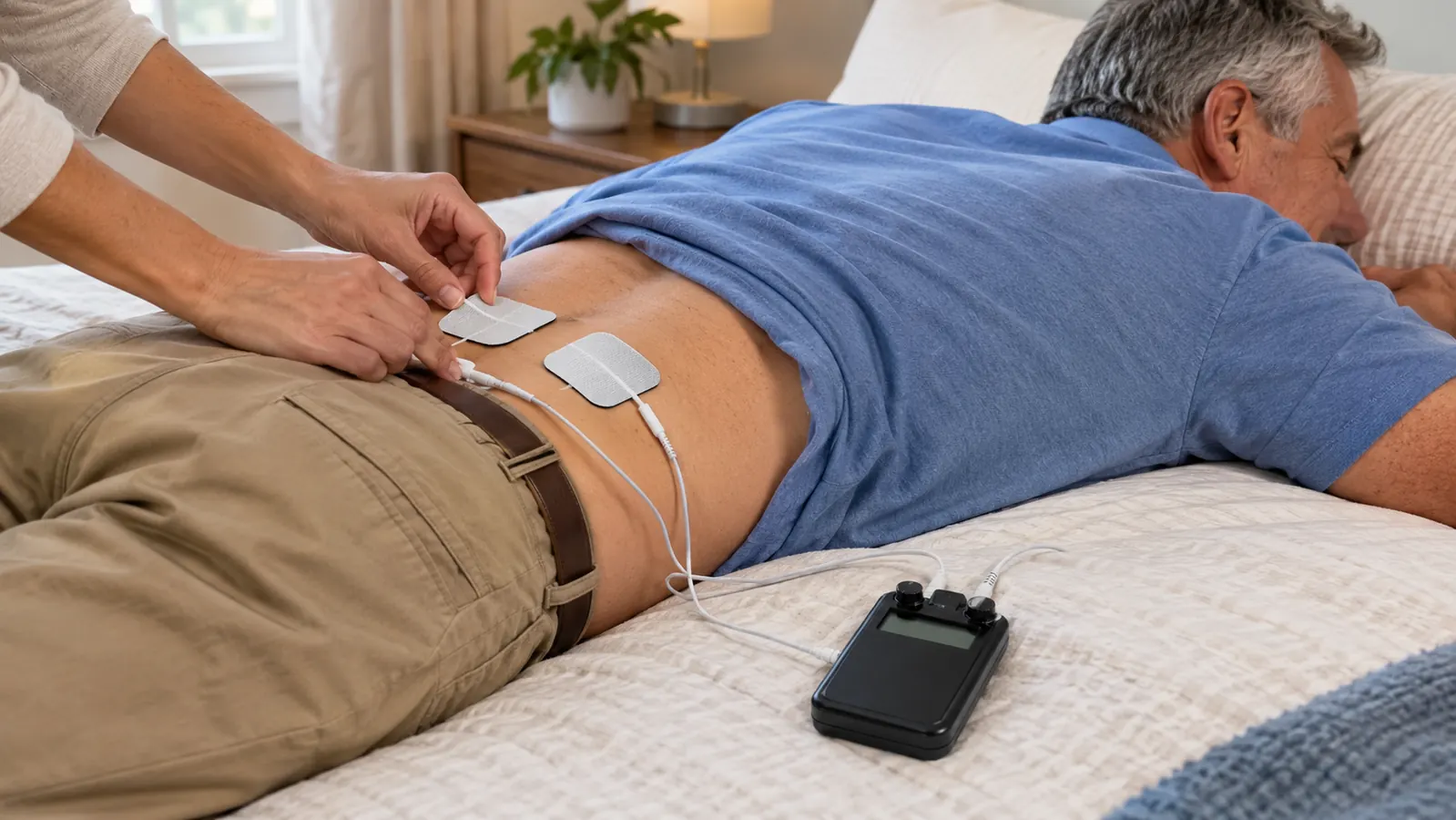
The TENS 7000 comes with four electrode pads and two sets of wires, which means I can cover the whole area that bothers me instead of picking one spot. I lie on my stomach on the bed, and I place two pads on either side of my lower spine, about an inch and a half from the center, right where the ache lives. The other two pads go a little lower, near the top of my glutes, because that is where my back refers the tightness after a long round.
The pads stick best on clean, dry skin, so I do this after my shower, not before. I have also learned to check the pads before I put them on. Once the gel starts to wear out, the pads do not stick evenly, and the TENS 7000 feels like it is buzzing in one spot and doing nothing in another. The kit includes spare pads, and I replace mine every few months depending on how often I use the unit.
If you are not sure where to put the pads, the instruction booklet that comes with the TENS 7000 has a diagram, and it is actually useful. The general idea is to bracket the sore area rather than placing a pad directly on the spine. I have never placed a pad directly over my backbone, and I would not recommend it. When in doubt, start with the pads on either side of the spine at the level of the discomfort and keep the intensity low.
Step 3: Start Low and Work Up to What Feels Right
The TENS 7000 has a dial that lets me set the intensity, and the first time I used it I made the mistake of turning it up too fast. It is not painful, exactly, but it is not pleasant either. The right setting for me is a strong, steady tingle that I can feel clearly without it ever crossing into discomfort. I usually start at a low level, let it run for a minute, and then nudge it up one notch at a time until it feels like it is actually working the tight area.
The unit has a few different modes, and I mostly use the standard continuous mode for my back. The burst modes feel different, and I will sometimes switch to one of them for the last few minutes, but I have never found that one mode is dramatically better than another. What matters more is the intensity and the placement. A session for me runs about 20 minutes, and I usually do one session in the evening and sometimes a shorter one the next morning.
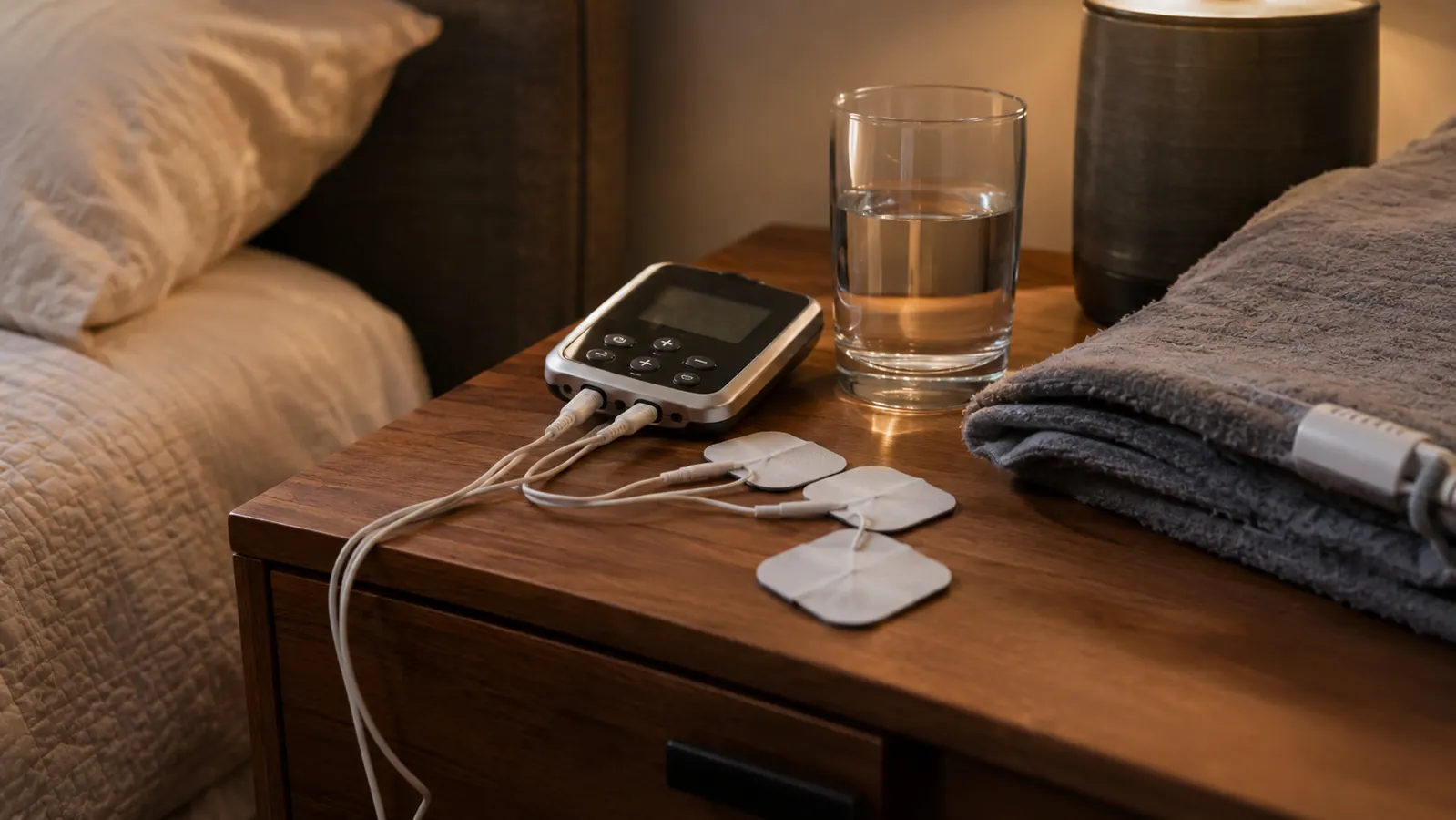
The TENS 7000 runs on a 9-volt battery, and it has a timer that shuts the unit off automatically. I like that, because it means I can set it, lie still, and not worry about falling asleep with it running. The display is easy to read, the controls are straightforward, and after the first session I did not need the manual again. That matters to me more than it should, but I am at an age where I do not want to fight with a device after a long day on the course.
Step 4: Lie Still and Let the Session Do Its Work
The temptation is to do something else while the TENS 7000 runs. I have tried reading, watching television, and scrolling through my phone, and none of them work as well as just lying still. When I stay quiet, I can feel the muscles in my lower back slowly letting go. It is not a dramatic release. It is more like the difference between a clenched fist and an open hand. By the end of 20 minutes, the area feels looser, and the ache has dropped from the front of my mind to somewhere in the background.
I lie on my back for part of the session and on my stomach for part of it, just to change the position of my spine. I keep a small pillow under my knees when I am on my back, which takes pressure off the lower back, and a pillow under my hips when I am on my stomach. These are small things, but they add up. The combination of the TENS 7000 and a supported position is what makes the session feel like a reset rather than just a buzz.
After the unit shuts off, I stay lying down for another few minutes. I have found that jumping up immediately undoes some of the benefit. I roll onto my side, push myself up with my arms, and stand slowly. Then I do a few gentle knee to chest stretches, nothing aggressive, just enough to remind my back that it can move. That transition from the TENS 7000 session back to normal life is part of the routine, and skipping it is how I end up stiff again by bedtime.
Step 5: Follow With Heat and a Good Night's Sleep
When the TENS 7000 session is done, I switch to a heating pad for 15 or 20 minutes while I read. The TENS 7000 works on the nerves, and the heat works on the muscles, and for me they complement each other. I have tried using them at the same time, and I do not recommend it. One at a time, with the TENS 7000 first and the heat after, is the order that works best for me.
I also pay attention to how I sleep. I am a side sleeper, and I have learned to put a pillow between my knees. It keeps my hips level and takes a surprising amount of strain off my lower back. Linda, my wife, teases me about the number of pillows on the bed, but she stopped complaining when I stopped waking up stiff and grumpy. A good night's sleep is the part of recovery that no device can replace, and the TENS 7000 is better at getting me to that point than anything else I have tried.
The next morning, I make a decision based on how my back actually feels, not on how much I want to play. If the stiffness is mild and loosens up as I move around the house, I will play, and I will use the TENS 7000 for a short session before I leave. If my back still feels tight and painful after breakfast, I skip the round. That is the honest math of living with a bulging disc for ten years. The TENS 7000 helps me recover, but it does not make me invincible, and I have learned to listen to the difference.
What Else Helps
The TENS 7000 is the centerpiece of my evening routine, but it is not the whole routine. I walk with a push cart instead of carrying my bag, which saves my back before the soreness even starts. I stretch for five minutes before I tee off, mostly hamstrings and hips, because tight hamstrings pull on the lower back. I drink water through the round instead of only coffee, and I have noticed that dehydration makes my back ache more the next day. And on the days when I am too sore to play, I walk anyway. A 30 minute walk, even a slow one, does more for my back than a day on the couch.
I also keep my expectations realistic. The TENS 7000 is a tool for managing the soreness that comes with playing a sport I love at 61. It is not a cure for a bulging disc, and no device is. What I can say is that the TENS 7000 has made the morning after a long round noticeably better, and it has helped me keep playing two or three times a week instead of giving up on the game. That is the standard I judge it by, and it meets it.
The TENS 7000 has made the morning after a long round noticeably better, and it has helped me keep playing two or three times a week instead of giving up on the game.
If Your Back Talks to You After 18 Holes, This Is the Unit I Would Start With
The TENS 7000 is simple, reliable, and has been in my routine for over a year. It will not fix a bulging disc, but it can take the edge off a stiff evening and a stiff morning. Check today's price on Amazon and see if it earns a spot on your nightstand.
Amazon Check Today's Price on Amazon →