

The morning after a round used to be the worst part of golf for me. I would wake up, swing my legs out of bed, and feel that familiar tight band across my lower back. By the time I got to the course, I would be moving okay, but the first tee always felt like a gamble. My name is Warren Oakes, I am 61, and I have played 18 holes two or three times a week at a municipal course in Albuquerque for years. A doctor told me at 52 that I had a bulging disc in my lower back, and his advice was simple: stay active, keep your core strong, and find ways to manage the stiffness. That is what led me to the TENS 7000.
I have now used the TENS 7000 for about six months, mostly on my lower back after a round and sometimes on the morning of a round when I wake up stiff. This is not a cure, and I am not a doctor or a physical therapist. It is a tool that has made a real difference in how I feel on the course and the day after. Here is what months of use have actually been like.
The Quick Verdict
The TENS 7000 is a straightforward, dependable muscle stimulator that has become a regular part of my post-round routine. It will not fix a bulging disc, but for dull, achy lower back stiffness it gives me 20 to 30 minutes of meaningful relief, and it has held up well through months of steady use.
Amazon Check Today's Price →A stiff lower back should not cost you the back nine
The TENS 7000 is the unit I keep in my bag for the mornings when my back needs a little help before I tee off. It is simple to set up, and the relief lasts long enough to get me through a round.
Amazon Check Today's Price on Amazon →How I've Used It
My routine has settled into two main uses. The first is the evening after a round. I get home, shower, and sit in my recliner with the TENS 7000 on my lower back for about 25 minutes while I watch television. I place two electrode pads on either side of my spine, just above the belt line, where the stiffness sits. The second use is the morning of a round, usually on the days when I wake up feeling tight. I will run a 15 minute session while I drink my coffee, then stretch and head to the course.
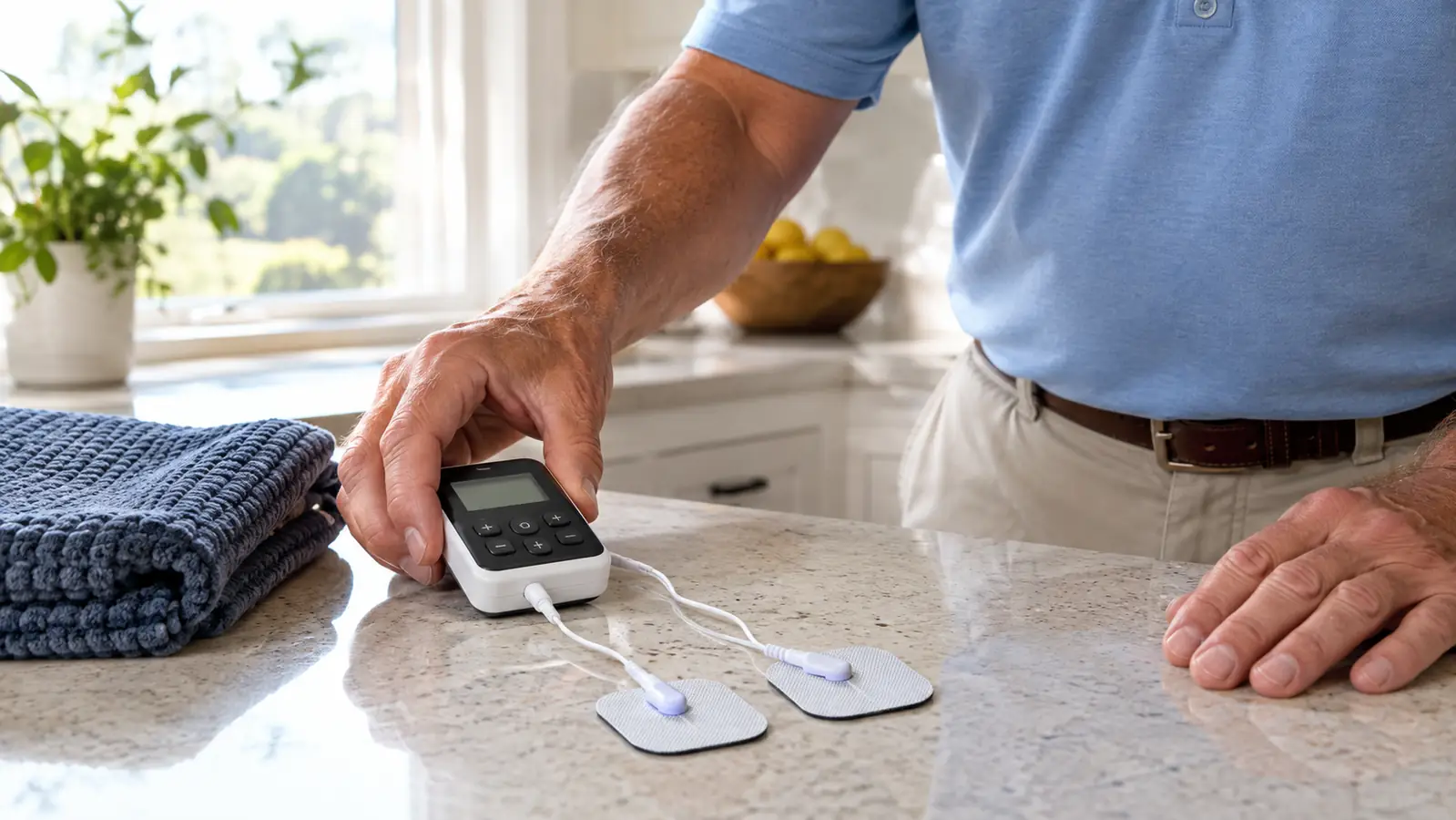
The TENS 7000 comes with a belt clip, a carrying case, and a set of electrode pads, and it runs on a 9 volt battery. I have replaced the battery once in six months, which surprised me given how often I use it. The unit has two channels, so I can run four pads at once, and the intensity dials are on the front. It is not a fancy device. The screen is simple, the buttons are basic, and that is exactly what I wanted.
I have also used it on my neck and shoulder after a long day of yard work, and it works the same way there. The pads stick well, the leads clip in securely, and I have not had a single issue with the unit itself. The only thing I had to learn was how to place the pads so the sensation felt good rather than sharp. Once I figured that out, the TENS 7000 became a regular part of my week.
What the TENS 7000 Actually Does
A TENS unit, which stands for transcutaneous electrical nerve stimulation, sends small electrical pulses through pads on your skin. The idea is that those pulses can interfere with pain signals going to your brain, and the sensation itself can also make a tight area feel less angry. I am not going to pretend I understand every detail of the science. What I can tell you is what it feels like and what it does for me.
When I turn it on, I feel a tingling, buzzing sensation under the pads. I usually start on a low setting and turn it up until it is noticeable but not uncomfortable. After a few minutes, the area around the pads feels warm and relaxed. For me, that sensation lasts well after the session is over, often for an hour or two. On a bad morning, that is the difference between starting a round stiff and starting a round loose.
The TENS 7000 has a few built in programs, but I mostly use the standard continuous mode. There is also a burst mode and a modulation mode, and I have experimented with all of them. The modulation mode, which varies the intensity, is the one I use most when I am sitting still. The burst mode feels more like a pulsing tap, and I use that one less often. The point is that you have options, and you can find what works for your body.
How It Has Held Up Over Months of Use
I have owned other TENS units before, and the reason I mention that is to give you a sense of what I am comparing it to. The TENS 7000 is built like a piece of medical equipment, not a toy. The case is solid, the buttons have a positive click, and the belt clip has not broken or loosened. I keep it in my golf bag during the season, which means it bounces around in the cart and gets jostled in the trunk of my pickup. It has never turned on by itself, never lost a setting, and never given me a single problem.
The electrode pads are the one thing you will need to replace. After about three or four weeks of regular use, the gel starts to wear out and the pads do not stick as well. The TENS 7000 comes with a set of pads, and I have bought replacement pads a couple of times. That is normal for any TENS unit, and it is not a knock against this one. The pads are easy to find, and the ones made for the TENS 7000 fit the leads perfectly.
The battery life has been the biggest surprise. I expected to be changing the 9 volt battery every couple of weeks, but I have only changed it once in six months. I use the unit three or four times a week, sometimes more, and it just keeps going. That matters to me because the last thing I want is a dead unit in my bag on a Saturday morning.
The TENS 7000 has never turned on by itself, never lost a setting, and never given me a single problem in six months of regular use.
What It Does Not Do
I want to be honest about the limits, because I think that is what separates a useful review from a sales pitch. The TENS 7000 does not fix the underlying problem. My bulging disc is still there, and my back is still stiff on some mornings. What the unit does is give me a window of relief that lets me do the things I want to do, like play golf and work in the yard. It is a management tool, not a cure.
It also does not work for sharp, shooting pain. My doctor was clear about that, and I will pass the same advice along to you. If you have pain that radiates down your leg, or pain that gets worse instead of better, or pain that came on suddenly after an injury, do not reach for a TENS unit. Talk to your doctor or a physical therapist first. The TENS 7000 is for dull, achy, familiar stiffness, not for new or serious pain.
One more honest note: the relief does not last all day. On my best days, I get a couple of hours of meaningful relief from a session. That is enough to get me through a round, but it is not enough to make me forget that I have a back. I have learned to use the TENS 7000 as part of a routine that also includes stretching, walking with a push cart instead of riding, and being smart about how I lift my golf bag.

My Routine With the TENS 7000 After a Round
I use the TENS 7000 the same way almost every time. After I get home and change, I sit in the recliner and place two pads on the muscles on each side of my lower back, a couple of inches out from the spine and never on it. I start the intensity at the lowest setting and turn it up slowly until I feel a steady tingle that is strong but not uncomfortable. If it starts to twitch the muscle hard, I back it down a notch. Then I set it for about twenty minutes and watch the evening news.
For me, the tingle seems to take my attention away from the dull ache that sets in after walking 18 holes. When the session ends, the ache is usually lower than it was, and I can get up from the chair without the slow, careful routine I used to need. It does not last forever. By the next morning I am usually back to my normal level of stiffness, which is why I pair it with stretching and the occasional heating pad session. The TENS 7000 is one tool in the bag, not the whole bag.
A few practical notes from months of use. The pads lose their stickiness after a few dozen uses, especially if you do not put them back on the plastic sheet, so budget for replacement pads. Clean, dry skin makes them last longer. And follow the safety rules in the manual: no pads on the front of the neck or across the chest, never while driving, and do not use it at all if you have a pacemaker or other implanted device unless your doctor says it is fine. I asked my doctor before I started, and I would tell anyone else to do the same.
What I Liked
- Simple dials that are easy to adjust with the pads already on
- A steady tingle that takes the edge off the post-round ache for me
- Runs on batteries, so it works in a recliner or a hotel room
- Twenty minute sessions fit easily into an evening
- Drug-free option to add to stretching and heat
Where It Falls Short
- Relief fades by the next morning, so it is not a long-term fix
- Pads wear out and need regular replacing
- Not safe for people with pacemakers or certain conditions without a doctor's okay
- It takes a few sessions to find the right pad placement and intensity
Who This Is For
The TENS 7000 is for someone like me: a recreational golfer with a stiff lower back who wants to keep playing without relying on pain pills. It is for the person who wakes up tight, spends 20 minutes loosening up, and then plays a perfectly good round. It is for the person who has already talked to a doctor, already knows their diagnosis, and is looking for a drug free way to manage the day to day stiffness.
It is also for anyone who wants a simple, dependable unit without paying for a bunch of features they will never use. The TENS 7000 does one thing and does it well. There is no app, no Bluetooth, no subscription. You put in a battery, stick on the pads, and turn the dial. For a lot of us, that is exactly the right amount of technology.
Who Should Skip It
If you have never talked to a doctor about your back pain, skip the TENS 7000 and make that appointment first. If your pain is sharp, radiating, or getting worse, a TENS unit is not the answer. If you are looking for something that will fix your back while you sleep, this is not it. And if you want a device that connects to your phone and tracks your sessions, you will be disappointed. The TENS 7000 is deliberately basic.
I would also say this: if you are not willing to use it regularly, it is probably not worth buying. A TENS unit is not a one time fix. It works best when it is part of a routine, and that routine takes a few minutes of your day. I use mine three or four times a week, and that consistency is why it has been worth the money to me.
The TENS 7000 is the unit I reach for on stiff mornings
After six months of regular use, the TENS 7000 is still the first thing I grab when my back is tight. It is simple, dependable, and it has earned a permanent spot in my golf bag.
Amazon Check Today's Price on Amazon →